Study for Meditation Mat

Study for Meditation Mat
Handspun Tapestry Weaving
Showing posts with label spinning meditation. Show all posts

Sunday, 4 March 2012

We Are One: Spinning to Calm the Roaring Spirit

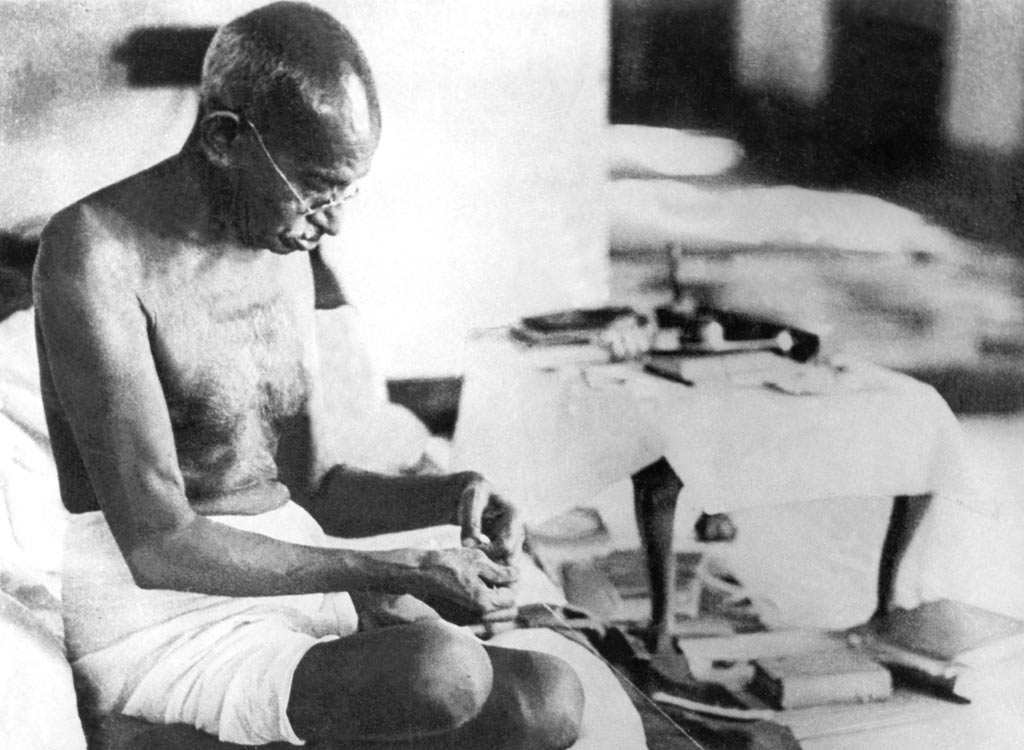
File:Gandhi spinning 1942.jpg
Gandhi spinning on a book charkha, 1942, Wikimedia Commons public domain photograph


What is it about spinning yarn that makes it so appealing as a meditation practice?  Why are spinners, some famous like Mohandas Gandhi, others unknown, drawn to the rhythm of the wheel or spindle?

Spinning, like meditation, is about doing, not about theory (although one can certainly study both spinning and meditation).  If you want to meditate, you must meditate; if you want to spin, you must practice with spindle or wheel and fibre.  No amount of reading or mere inquiry will make you a meditator/yogi or a spinner. 

Like meditation, spinning is simple, not easily done well.  Meditation is more than sitting, more than reflection and much more than watching or controlling your thoughts.  Only a few yogis achieve emptiness, or still mind.  Only by lengthy, sustained practice will a spinner develop muscle memory, control and deep understanding to the point where she becomes one with her yarn.

If you are a karmayogi, like Gandhi, spinning can be a means of practical service.  Although we need not concern ourselves with the yarn forming when we meditate, the resulting yarn can be used to cloth ourselves and others, to provide care and comfort to people suffering.

The mechanics of spinning yarn are ideally suited to meditation, the practice of staying in the Now, being with your thoughts, yet not being your thoughts.  As Gandhi discovered, the whir and clicking of the charkha soothes the mind and brings peace to the spirit. (In his autobiography, Gandhi speaks of how the sound of ashram women spinning helped heal him from illness.)  Both spinning and meditation can calm the roaring mind; angry, upset, we sit or spin or practice both.  After a time, the anger settles, the upset decreases and we no longer feel that we are our emotions.

Meditation helps release attachment, to habits, to emotions, to the human condition. When we practice unsupported long draw, as required when spinning cotton at the charkha, we must maintain focus and a light touch. Spinning cotton is a practical reminder that attachment brings suffering-if our attention wanders, if we clutch the fibres, our yarn becomes sloppy or breaks.

When we spin, we are connected to a larger self, the part of us that is about spirit and community.  Spinning connects us to all spinners who have gone before us, who made possible the cloth that allowed humans to move across the planet, to stay alive.  Spinning connects us to communities here,  through shared experiences with local, national or international spinning circles. Like meditation, spinning can relieve us, if only for a moment, of our sense of being alone, lost in a sea of constant changes. In this way, spinning provides us with a tool to connect with the larger self that is found in meditation, whether we see that larger self as something within us or as a link to a universal whole.

The next time you sit down at your wheel or pick up your spindle, try spinning in meditative reflection.  Stay present (i.e., don't "zone out" or concern yourself with what the yarn will become) and focus on what is happening as your hands move, the fibre changes, the yarn forms.  Pay attention, the way you would were you meditating on a candle flame, and see if the rhythm of the spinning whorl as meditation/yoga practice helps to soothe the chatter of the whirling mind.

File:Gandhi spinning.jpg
Mohandas Gandhi spinning, late 1920's, Wikimedia Commons, public domain photograph

Sunday, 15 January 2012

Higher: Using Spinning as Meditation Practice

Much of yoga principle and thought is based on the notion of inward, outward and upward.  A yogini turns inwards to meditate and still the chattering mind.  She may then move outward, putting effort into right work and right action.  The ultimate goal is to move upward to a higher Self, an Absolute.  What all this comes down to, as I see it, is that we examine our "self," whatever that may be and make an effort to use any knowledge to make our world a better place.  Whether or not that involves an Absolute or just what that Absolute might be is up for debate.

How can we use spinning, knitting, etc. to practice yoga?  We know that intense focus on spinning and knitting can lead to calming states, although these states may be more "zoning out" than becoming attuned. It's fairly easy to extend this knowledge into deliberate yoga/meditation practice.  Find yourself a spindle, some fibre, a quiet, comfortable space to sit and begin.

Set a timer for 10 to 15 minutes.  That time will be devoted to spinning and only spinning.  You will not be spinning for a purpose; you will not be spinning to fill time, to busy your hands while you watch television.  You will not be spinning to escape anything; rather, your full attention will be on the spindle, the movement of fibre into yarn, the winding of yarn onto the spindle shaft, without judgment.  Every time your mind wanders (and it will), bring your attention back to the spindle.  If it helps your concentration, focus on one aspect of spinning, such as the turn of the whorl or drafting, or the feel of the yarn as it changes from fibre to string.


At first you'll be restless, even if (perhaps especially if) you are an experienced spinner.  You will wander off into thinking, judging your actions and their results.  When you become aware of this, gently bring yourself back to spindle and yarn.  The awareness of wandering mind is part of mindfulness.  You will think, "This is silly, boring, useless, fun, whatever."  None of this matters.  Remember, you don't have to like the practice; you just have to do it.  Stay with it, no matter how difficult or easy this practice seems, until the timer ends your session.  Slowly, put spindle and fibre aside and resume your usual activities.

Doing daily spinning meditation sessions, 10 minutes a day, is akin to the time you spent learning to spin in the first place.  Here, you're training mind to stay in the moment, to bring your full attention back to spinning, not allowing the muscle memory you developed when you learned to spin to lull you into mindlessness.  Keep at it and you may find that your "monkey mind" becomes a bit calmer and you move into stillness more easily.

It's a simple idea, but it must be practiced, rather than explained, in order to receive any benefits which may or may not occur.  Start now.  Pay attention.

Simple.  Not so easy.

Namaste.

Wednesday, 31 August 2011

We are Stardust: Reflections on Spinning and the Space Between Us


Last night was the final session of the spinning as meditation class.  Six of us sat and applied our spinning and knitting skills to meditation exercises. 

The energy among us changes as we move deeper into practice.  You can feel this energy becoming softer, calmer, as "the space between us" (Thanks, Mr. DD!) flows into a deep sense of connection. 

There is a lovely meditation in which we reflect on all elements which give rise to our present circumstances.  It's a simple practice.  Choose something in your life-food, a treasured object, a loved one, a skill, anything at all-and express gratitude for all the things which allowed this to come into existence.

Spinning and fibre arts are ideal candidates for this meditation.  As you spin, think of everything which brought you to this pleasure.  There are the tools you use, the makers who crafted those tools, the materials which comprise spindle or wheel.  Think of the elements required to grow the wood for those tools-wind, rain, nutrients, insects, other animals who deposited the seeds, to name just a few.

There are the fibres we spin: consider the animals and plants from which they come, the people who raised and harvested our fibres.  We can reflect on the "ancestory" (this spelling intended) of our knowledge.  Who taught us these skills?  Who taught them?  What conditions brought us to this moment, spinning?

A Tabachek bottom whorl spindle and bowl, yarn from Romney fleece, a ball of silk singles, sitting on a handwoven coaster of commercial cotton and hand spun, dyed wool


On and on it goes.  We trace our lineage through time, expressing gratitude to everyone and everything who contributed to our work.

When we practise this meditation, we realize that all things are interconnected and that our personal lives and skills encompass all.  No one person and no one thing arises on its own-we truly do come from stardust, eventually to return.  I'm grateful for that.

Thanks to all the fellow travellers on this journey.

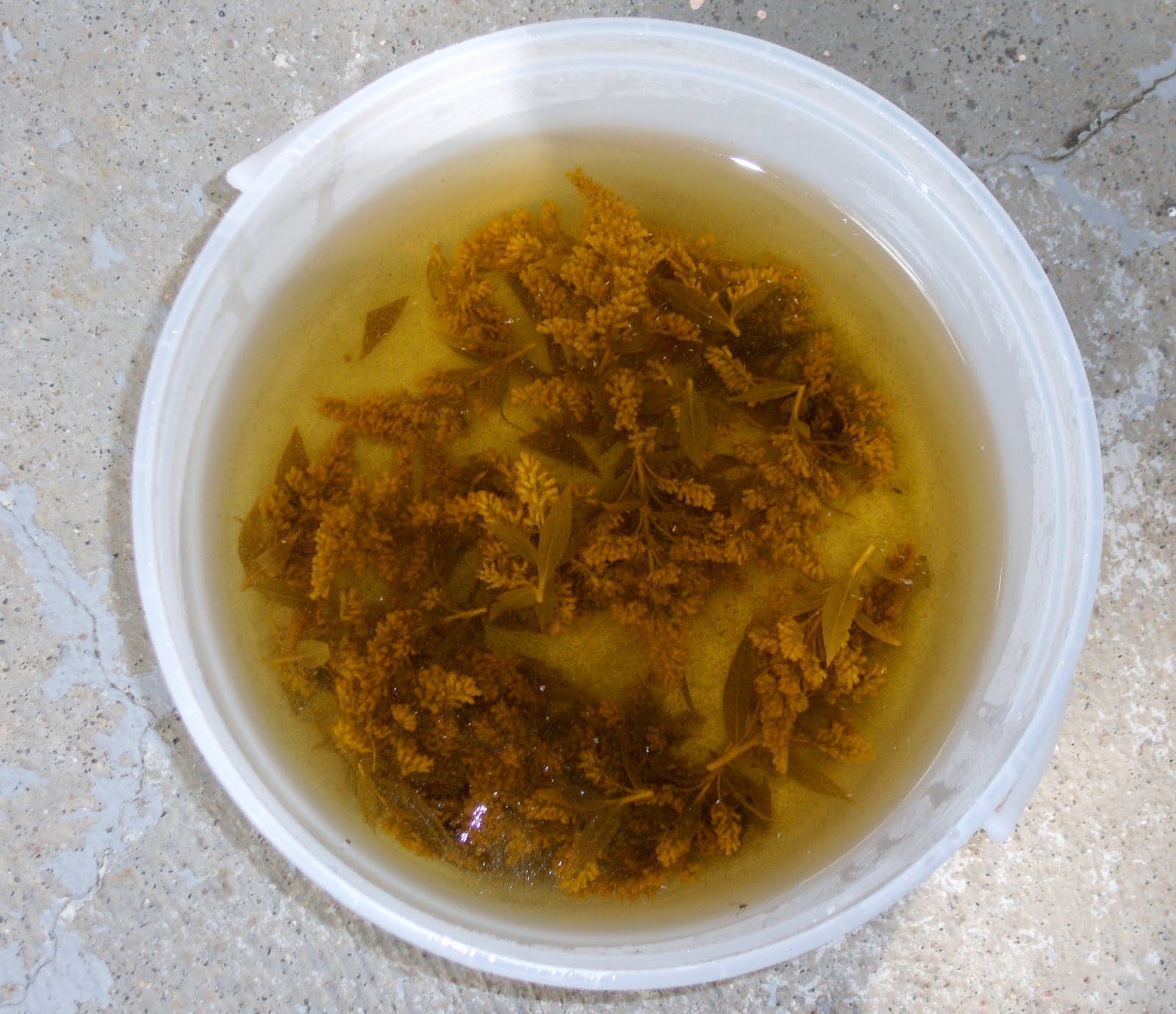
A bucket of goldenrod flowers waiting to become dye

Thursday, 11 August 2011

Hot Town: Spinning in the City

We've had a tent revival of sorts around here in the last few weeks: there have been spinning demonstrations and classes all around the city.  Last week, a group of spinners, doglover and MuddyPawsKnits among them, demonstrated spinning at the Queen City Ex.  These volunteers generated a lot of interest in fibre arts, especially thanks to eleven year old Katie, doglover's niece.  Katie impressed everyone with her spinning skills.  There are pictures up on Ravelry, under the Regina Stitch and Bitch and the Golden Willow groups. (You can see the famous Jeremy, Susie's husband,  and his brilliant skein of yarn.)

I taught two workshops for the public library and both were full.  The second class was supposed to be the overflow from the first class's waiting list, but we managed to have more people in that class than in the original.  By last night, 22 people from those classes were new spinners and we hope to bring more into the light because of the women who helped out at the Ex.

My workshops were hectic.  I have only one photo of the first class:


I forgot to take photographs of the second class learning to spin.  The pictures here were taken last night, as the class practised plying:


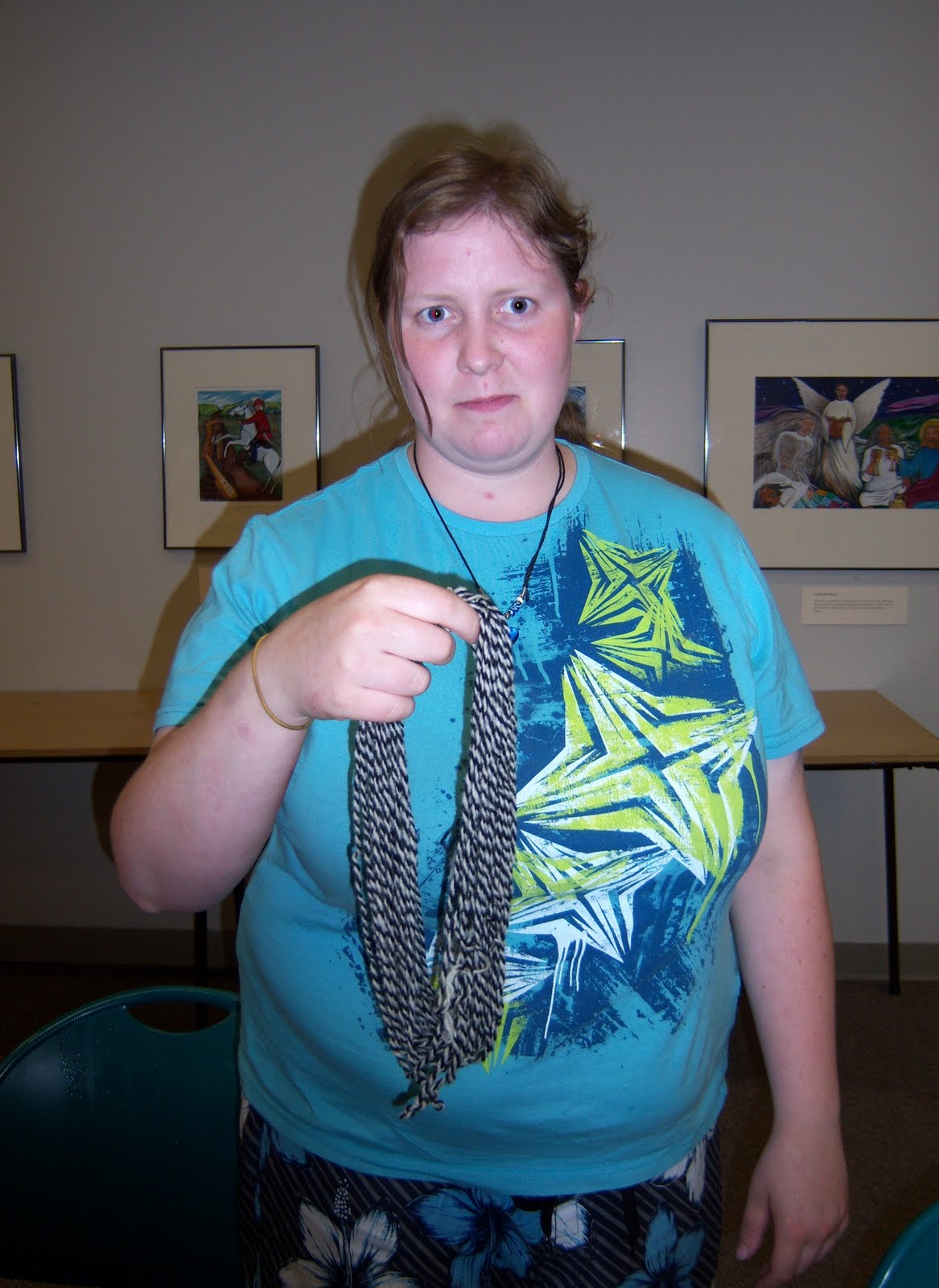
And here they are, with their washed and whacked skeins.  They did very well:


The spinning and meditation classes begin next week.  So far, about fifteen people have expressed interest in attending one or more sessions, which amazes me (in a good way), considering that either practice alone is not that common here; doing both together could be seen as downright strange.  I'm looking forward to the sessions.

If you want to be among fellow spinners or get yourself started, this is the place to be.  Who says nothing ever happens here?!

Thursday, 4 August 2011

YOU ARE CORDIALLY INVITED TO ATTEND…

Heart Like a Wheel: Spinning and Fibre Arts as Meditation Practice
Location:  Bodhi Tree Yoga Studio at 3104-13th Avenue, Regina (Upstairs from Golden Willow)

Fibre artist Deborah B holds a Master's Certificate in Hand Knitting (TKGA) and has taught spinning, knitting and weaving classes throughout Western Canada.  In these sessions, she will help you begin a simple meditation practice by mindful application of your spinning and fibre arts skills and tools.

Dates:  Tuesdays, August 16, 23, 30, 2011
Times:  7 to 9 pm.

(Donations Only)

Please preregister: dragondancer01@gmail.com


Monday, 1 August 2011

Dazed and Confused: Concentration, Mindfulness and Spinning as Meditation

I want to explain more about the difference between using spinning as meditation practice and our normal spinning habits.  I’ve written about the difference between relaxation and meditation and how spinning to relax or zone out is not meditation.  Spinning in meditation is not concentration, either, that state of mind where we are striving to hold on to something, be it a thought, a movement, a skill.  Spinning as meditation is not training.  Somewhere in the middle of concentrating, training, sits our spinning meditation.


We often speak of “beginner’s mind,” that state of being one has when exploring new territory, an open-ness to possibilities.  The beginning spinner has countless options when learning her craft; the expert, through her knowledge, may not.  That open-ness is necessary in meditation, but beginning spinners (and others who are learning new skills) also use focus and concentration to help them learn.  This is where applying spinning skills to meditation can become confusing.
Just as meditation is not “zoning out,” neither is it “concentration” or “focus.”  Concentration and focus require a harnessing of thought, an effort to keep ourselves, our physical movements, our thoughts on track, attentive to the task at hand.  Beginning spinners have trouble with this—they are so busy trying to get everything just right that they can’t let go and let things happen.  Yet, it’s precisely when we let go and let things happen that something clicks and, hey, you’re spinning!
It’s that point of letting go that defines a meditation practice.  Thoughts are not good or bad; they simply “are.”  The movements you make, the yarns you produce in spinning meditation are also not good or bad.  They are simply part of the process.  Being mindful means we are attentive to what is happening now.  Awareness means we don’t cling to what mindfulness shows us.
When we are concentrating, we are trying to hold on to something.  When we are aware, we are simply allowing things to be.  So spinning as meditation practice involves using our craft as a stepping stone—we appreciate the rhythm of wheel or spindle, the sensations of the fibres flowing through our fingers, the yarns as they form.  We appreciate the annoyances, too—the way the fibres refuse to draft smoothly, the yarn as it snaps, the spindle as it hits the ground.  All of this is part of our practice.
There is no goal.  If, in bringing our attention to our spinning we find that our yarns improve, that is part of the process as well, but we don’t look for that.  It may happen; it may not.  When we spin to meditate, we let go.  Eventually, we may find that we can let go of our spinning, which is simply a support in our practice.  At that point, we can just sit.  We no longer meditate, but we are in constant meditation.
Again, being in meditation is simple, not so easily practised.  In the meantime, let’s use what we have to help us in our practice.  Just don’t think too much about it!


Friday, 1 July 2011

I Will Remember You

We returned home from Olds last night, tired but happy.  It was a great week.  I'm still unpacking and sorting, but I'll give you a photo exhibit of some of the action.  We were at this beautiful campus, with flora:


and fauna:


There was knitting:


and weaving:


and spinning, of course.  Lots and lots of spinning:


There was the Saskatchewan contingent at the Spin In:


Some of us were very young:


We could buy a lot of stuff:


There was a Fashion Show with beautiful hand spun, hand knitted lace wedding ring shawls:


and wonderful art pieces:


I worked on my bat cape.  Here, the bats are nearly out of the belfry:


They finally made it, so Judi Dixon took this picture:


We had a wonderful time.  Thanks to all the kind souls who came to the spinning meditation workshops and allowed me the honour of practicing with them.  I'll post more on Fibre Week later, but now, I'm off for a good, long sleep.


Namaste.