I promised to show you my haul from down South, so here are these two beauties:
Both spindles are KCL spindles, made by Ken Ledbetter. The top photo shows my baby, 30 grams of Maple whorl with Candy Pyolite inlay. It has 3 interchangeable shafts, intended for plying, but I'm hoping to use it as a travelling sample spindle. I can switch out shafts when I want to change fibres.
The bottom photo is a 24 gram spindle of Sycamore and Dyed Maple. She is simple, but beautiful and spins well. (Any KCL spindle I've tested spins well.) Susan Z. has claimed her.
The spindles came from TempeYarn and Fiber, a lovely yarn store right next to the hotel where we spent our first night. (Coincidence? I think not.) The owners and staff were very friendly. I was there a few times and joined the local knitting group for a few minutes before heading out. Along with the spindles, I bought some locally dyed silk roving, organic cotton, in prepared punis and bolls, plus 2 small balls of yarn for road trip knitting. (I am unhappy with my handspun trip knitting and suspect it will be binned shortly.)
I also visited Jessica Knits in Scottsdale, AZ. Again, everyone was welcoming. I picked up a skein of locally hand dyed silk noil yarn, some sale needles and moisturizing products for knitters. This shop didn't carry any spinning products, but carried Atenti and Lantern Moon Bags. Somehow, I managed to resist those.
I was surprised at the amount of wool yarn in both stores. The people At Tempe Yarn and Fiber told me that wool was their most popular fibre, even in the Arizona heat. They do sell more cotton in the summer, but "wool is just so nice to knit with," it's always in demand.
I've spent the last two days recovering from travel time, submitting my Yoga Course Final Exam and catching up on local news. Beginners' Spinning Class started last night and, with Susan's and Sharon's help, I muddled through, despite my fatigue-induced goofiness. (Yup, that explains it. This time.)
We had 3 brand new spinners, 1 refresher student and we hope to have two more newbies next week. After suffering through all my spinning blah, blah, blah, we got everyone started with toy wheel top whorl spindles and some Romney roving which Sharon donated. Everyone was spinning yarn within twenty minutes and, by the end of the two hour class, everyone had impressively consistent yarn. Everyone learned how to prop a spindle elegantly between their knees in order to Park and Draft. They also discovered why they should wear blue jeans to class.
I love teaching people to spin. It's fun to watch as they learn how simple it is to make yarn and how interesting string can be. I never stop my efforts to lure people into the art - I had Gwen, one of our housemates, spinning on a yo-yo spindle while we sat by the pool in Phoenix. (She was too shy to pose for a picture, but her spinning was very nice - fine, consistent and evenly twisted.) She resisted my offer of a spindle loan, but said she'd stop by the store when she was home to see what we were doing.
So, I'm back on the wheel, readjusting to daily routine after our mini-break. Morris was delighted to see his Dad; Mickey was delighted to see me and Richard, the wonderful brother-in-law, was delighted to return home, minus squirrelly bull terrier and demanding twenty pound cat.
Life is good. Namaste.
THE RAMBLINGS OF A DEVOTED FIBRE FANATIC.
Study for Meditation Mat
Handspun Tapestry Weaving
Showing posts with label beginners' spinning. Show all posts
Thursday, 19 April 2012
Saturday, 17 March 2012
Walk This Way
Sarah gave us a lesson in walking this week. "Bodhi Tree Finishing School," she calls it. We positioned ourselves in Tadasana, then walked while learning to place our feet properly (heel to toe action, not up and down bouncing). We swung our hips while pushing off from the back foot. Then, we attempted all this while carrying 15 pound sandbags on our heads. It was no small feat, I'll tell you. (Yes, that horrid pun was intended.)
Sarah recommends wearing flat soled shoes, shoes that allow you to feel the ground under you, that don't restrict your feet, especially your toes. Ideally, we would walk on grass and walk barefoot. This isn't always practical, but we can start by going barefoot in the house.
What on earth does this have to do with spinning? A lot, actually. The next time you sit at your wheel, pay attention to the way you move at your wheel. Go barefoot or wear socks. Stand in Tadasana before you sit; keep your back straight, but relaxed, with elbows in and shoulders down and relaxed. Your chair should be firm, but comfortable, not so low that you are reaching up to the orifice, nor so high that your feet can't touch the ground without effort.
Check your alignment. Are your ankles stacked directly under your knees? If not, adjust your chair or wheel.
Place both feet evenly on the treadles. (I'll assume double treadle here. Use both feet on a single treadle wheel.) Don't lift your feet up as you treadle, but think of treadling heel to toe, in a rocking motion. I know a number of spinners who treadle with the outside edges of their feet or who shift their weight inwards on their ankles. Keep your feet flat as you treadle and be aware of the weight distribution on them. Do you feel balanced? You can treadle as quickly as you wish, but don't bounce and be aware of any discomfort in the ankles or the knees. Take frequent breaks.
If you're like me and get lost in the spinning, try setting a timer. I have a meditation bell app that I can set to ring at intervals. That bell helps me to check in, to my posture and to my spinning. Have I shifted from mindful spinning to habitual spinning? Is my body still comfortable, but aligned?
Checking your posture as you spin will not only help you spin comfortably for longer sessions, it will turn your spinning activities into mindful awareness. If you're paying attention, you'll spin more consistently, you'll catch problems early on and your yarn will improve.
The next time you sit at your wheel, take some time to sit before you spin. Your body and your yarn will thank you.
And, thank you, Sarah!
Namaste.
Happy Saint Patrick's Day! (In memory of my Dad.)
Sarah recommends wearing flat soled shoes, shoes that allow you to feel the ground under you, that don't restrict your feet, especially your toes. Ideally, we would walk on grass and walk barefoot. This isn't always practical, but we can start by going barefoot in the house.
What on earth does this have to do with spinning? A lot, actually. The next time you sit at your wheel, pay attention to the way you move at your wheel. Go barefoot or wear socks. Stand in Tadasana before you sit; keep your back straight, but relaxed, with elbows in and shoulders down and relaxed. Your chair should be firm, but comfortable, not so low that you are reaching up to the orifice, nor so high that your feet can't touch the ground without effort.
Check your alignment. Are your ankles stacked directly under your knees? If not, adjust your chair or wheel.
Place both feet evenly on the treadles. (I'll assume double treadle here. Use both feet on a single treadle wheel.) Don't lift your feet up as you treadle, but think of treadling heel to toe, in a rocking motion. I know a number of spinners who treadle with the outside edges of their feet or who shift their weight inwards on their ankles. Keep your feet flat as you treadle and be aware of the weight distribution on them. Do you feel balanced? You can treadle as quickly as you wish, but don't bounce and be aware of any discomfort in the ankles or the knees. Take frequent breaks.
If you're like me and get lost in the spinning, try setting a timer. I have a meditation bell app that I can set to ring at intervals. That bell helps me to check in, to my posture and to my spinning. Have I shifted from mindful spinning to habitual spinning? Is my body still comfortable, but aligned?
Checking your posture as you spin will not only help you spin comfortably for longer sessions, it will turn your spinning activities into mindful awareness. If you're paying attention, you'll spin more consistently, you'll catch problems early on and your yarn will improve.
The next time you sit at your wheel, take some time to sit before you spin. Your body and your yarn will thank you.
And, thank you, Sarah!
Namaste.
| It's time to switch to light weight socks. |
Happy Saint Patrick's Day! (In memory of my Dad.)
Friday, 9 March 2012
Give Her a Hand: Spinning and Mudras

![]() |
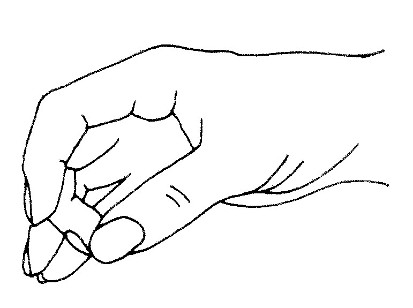
| Shuni Mudra, said to provide patience and discernment (Public Domain Images) |
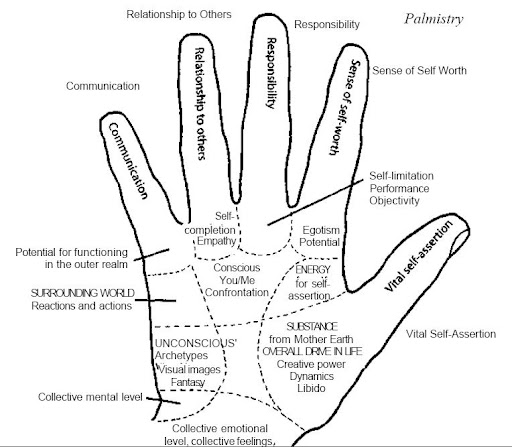
Do these hand gestures look familiar? They are yoga mudras, gestures meant to control body energy, stimulate emotions, cure disorders and delight the gods. Mudras have been used in many cultures, but most of them are familiar to us through yoga and Indian culture. Depending upon which tradition you consult, the number of mudras (not all are hand gestures) varies. (108 is a popular number.) We see them on Hindu and Buddhist images. Mudras are important traits of Kathak, a traditional Indian dance form or in meditation practices.
A spinner may be reminded of something else. These mudras are similar to the hand positions we use when spinning, for drafting fibres, guiding the thread or smoothing our yarn. Whether we realize it or not, we position our hands in gestures simulating mudras every time we spin. Since many of the mudras are believed to induce calm, patience and perserverance, is it any wonder than so many spinners discover a sense of relaxation when they sit at wheels or pick up spindles?
The next time you spin, pay attention to the way your hands move as they hold the fibres. Investigate mudras and their possible benefits. Explore a variety of mudras while you spin. In true yoga fashion, Be a Scientist and seek to discover a new way of looking at your craft.
Namaste.
![]() |
| Relationship of yoga palmistry, mudra and their effects on the body, health and emotion. (Public Domain Image) |
Thursday, 9 February 2012
You Spin Me Right Round, Baby: Working Through Confusion
Yogash chitta vrtti nirodhah.
(Yoga mind whirling stopping.)
--The Yoga Sutra of Patanjali 1.2
Almost everyone with a more than passing interest in yoga has heard of Patanjali’s Sutras and knows that these oral traditions/texts are important. My question has been, “Why?” These threads are not instructive epics or parables which capture the imagination through story-telling. They’re not commandments providing explicit direction for behaviour. Even allowing for the confusion caused by working with a translation of the Sanskrit and the fact that the commentaries were written long after the original oral form, the Yoga Sutra reminded me of the ramblings of a group of intoxicated people, sitting around a fire, entertaining one another with their Deep Thoughts. There is much talk of whirling mind and how to stop this, but attempting to understand these sutras on my own just makes my head spin more.
Stoned camping may make for a good time, but it doesn’t often produce works which capture the human imagination for thousands of years. Clearly, my “why” stems from my modern perspective and lack of understanding of these texts. My course is providing an opportunity to study the sutras and some of the commentaries on them. What I've come to understand is that Patanjali’s Yoga Sutra is a shorthand guide for those attempting deeper practice of yoga. Without a guide or guru, the sutras are difficult or impossible to understand. With guidance, exposition and practice, they shine light.
There is a parallel in yarn spinning, which I think is rather fitting, given that “sutra” translates as “thread” and I am interested in both actual and metaphorical threads. With proper instruction, a student will quickly understand what I want her to do when I say, “Spin Z” or “Ply S.” Given two words, she knows that she is to work in a specific way. If I add a few more common spinning terms, which are likely incomprehensible to a non-spinner, that student can spin a precise yarn. (In order to understand the nature of that yarn, she must actually spin it, not simply think about what it would be like.) Thus: “Spin 2Z worsted 6 tpi; ply 2S 3tpi” means “Spin 2 yarns using parallel fibres clockwise with a short backward drafting technique, giving each yarn 6 twists per inch. Twist these 2 yarns together counterclockwise so that the finished yarn contains 3 twists per inch.”
As much as we may enjoy discourses on string, we can't learn to spin without making yarn. Not only that, our spinning skills develop more quickly and strongly if we have a knowledgeable guide to help us. (If you doubt this, try learning to spin by simply reading Mabel Ross, Allen Fannin or Alden Amos. If you're anything like me, trying to understand Ross's shorthand without actual spinning the yarn makes my mind whirl more that the Yoga Sutra ever could.)
The next time your spinning practice gets stuck, do your best to find a living, breathing spinner to help you with your problems. That spinner doesn't have to be a "realized master" or even an expert. Just look for someone who studies her craft, with attention and some devotion, with a good understanding of how to help you with your problems. Be grateful that you probably won't have to do this by sorting through layers of translation from Sanskrit. On the other hand, I'm thinking that learning Sanskrit seems a perfectly reasonable thing to do right now.
| A knowledgeable teacher may help you get from here |
| To here |
Monday, 30 January 2012
Life is a Highway: Travelling the Yoga and Fibre Road
When we walk the path of yoga and meditation, there's no end to the journey, at least while you're on this planet. You take yoga practice as far as you like - you can experiment with a few postures and stop there, go a little further along the path with meditation, or spend your life exploring the meaning and value of sustained practice. What you do and where you go is up to you, with one caveat: if you decide that you've found "the answer" to it all, your practice will come to a halt. Once you think you've stumbled across the true meaning of life, you've lost it. Yoga travels along an endless, meandering path; that thing you think is home is really a giant boulder, an obstacle in your road.
It's that way with spinning, knitting and fibre arts, too. As long as we continue to explore the arts we love, we continue to learn. Although I have decades of spinning and knitting behind me, there are mountains of knowledge I haven't climbed. Even small things can bring us joy when we discover them for the first time.
I learned Norwegian cast on yesterday. It's a simple variation on Long Tail cast on, but provides a stretchy edge which is great for socks. I learned this technique from a DVD in the Deluxe Edition of The Knitter's Companion, by Vicki Square. I have the earlier edition and it's wonderful, but I'd meant to update to the new one. Sharon at Golden Willow gave me a copy of the new version on Saturday. It was a wonderful, helpful gift and the DVD's contain many demonstrations of things I do not know.
I know a fair bit about knitting, including several cast on methods, finishing techniques and blocking methods, but if I had decided that I knew all I needed to know about knitting, I would have missed the information contained in this knitting guide. By staying open to new possibilities, I now have fresh ideas which can improve my own work and which may help me with my teaching. What I learned isn't earth-shattering, but it's new and fresh and helps to keep my brain active.
The next time you are offered new possibilities and are undecided about taking them, ask yourself this: further down the road, will I regret not taking the opportunity to do . . . ? If the answer is "yes," then take the leap. At worst, you can only fail; sometimes failure is our best teacher.
If I didn't step away from the obstacle of knowing-it-all, I'd never have explored linking spinning, knitting and fibre arts to meditation. If I believed I knew all I needed to know about yoga, I'd never taken a class I'm enjoying thoroughly. If I thought there was no way I could guide a yoga therapy class, I would never have been given the opportunity to teach one.
It's fine to take a break from whatever you are exploring in life, but never stop travelling. There are so many learning opportunities, even if those opportunities are small things, like a new way to start your knitting or a variation on how you build your spindle cop. It's the small things that enrich us and expand our world. Keep exploring.
Namaste.
It's that way with spinning, knitting and fibre arts, too. As long as we continue to explore the arts we love, we continue to learn. Although I have decades of spinning and knitting behind me, there are mountains of knowledge I haven't climbed. Even small things can bring us joy when we discover them for the first time.
| The crocheted blanket is coming along nicely. |
I learned Norwegian cast on yesterday. It's a simple variation on Long Tail cast on, but provides a stretchy edge which is great for socks. I learned this technique from a DVD in the Deluxe Edition of The Knitter's Companion, by Vicki Square. I have the earlier edition and it's wonderful, but I'd meant to update to the new one. Sharon at Golden Willow gave me a copy of the new version on Saturday. It was a wonderful, helpful gift and the DVD's contain many demonstrations of things I do not know.
I know a fair bit about knitting, including several cast on methods, finishing techniques and blocking methods, but if I had decided that I knew all I needed to know about knitting, I would have missed the information contained in this knitting guide. By staying open to new possibilities, I now have fresh ideas which can improve my own work and which may help me with my teaching. What I learned isn't earth-shattering, but it's new and fresh and helps to keep my brain active.
The next time you are offered new possibilities and are undecided about taking them, ask yourself this: further down the road, will I regret not taking the opportunity to do . . . ? If the answer is "yes," then take the leap. At worst, you can only fail; sometimes failure is our best teacher.
If I didn't step away from the obstacle of knowing-it-all, I'd never have explored linking spinning, knitting and fibre arts to meditation. If I believed I knew all I needed to know about yoga, I'd never taken a class I'm enjoying thoroughly. If I thought there was no way I could guide a yoga therapy class, I would never have been given the opportunity to teach one.
It's fine to take a break from whatever you are exploring in life, but never stop travelling. There are so many learning opportunities, even if those opportunities are small things, like a new way to start your knitting or a variation on how you build your spindle cop. It's the small things that enrich us and expand our world. Keep exploring.
Namaste.
| Mickey (aka The Buddha) explores new possibilities for my sweater. |
Thursday, 11 August 2011
Hot Town: Spinning in the City
We've had a tent revival of sorts around here in the last few weeks: there have been spinning demonstrations and classes all around the city. Last week, a group of spinners, doglover and MuddyPawsKnits among them, demonstrated spinning at the Queen City Ex. These volunteers generated a lot of interest in fibre arts, especially thanks to eleven year old Katie, doglover's niece. Katie impressed everyone with her spinning skills. There are pictures up on Ravelry, under the Regina Stitch and Bitch and the Golden Willow groups. (You can see the famous Jeremy, Susie's husband, and his brilliant skein of yarn.)
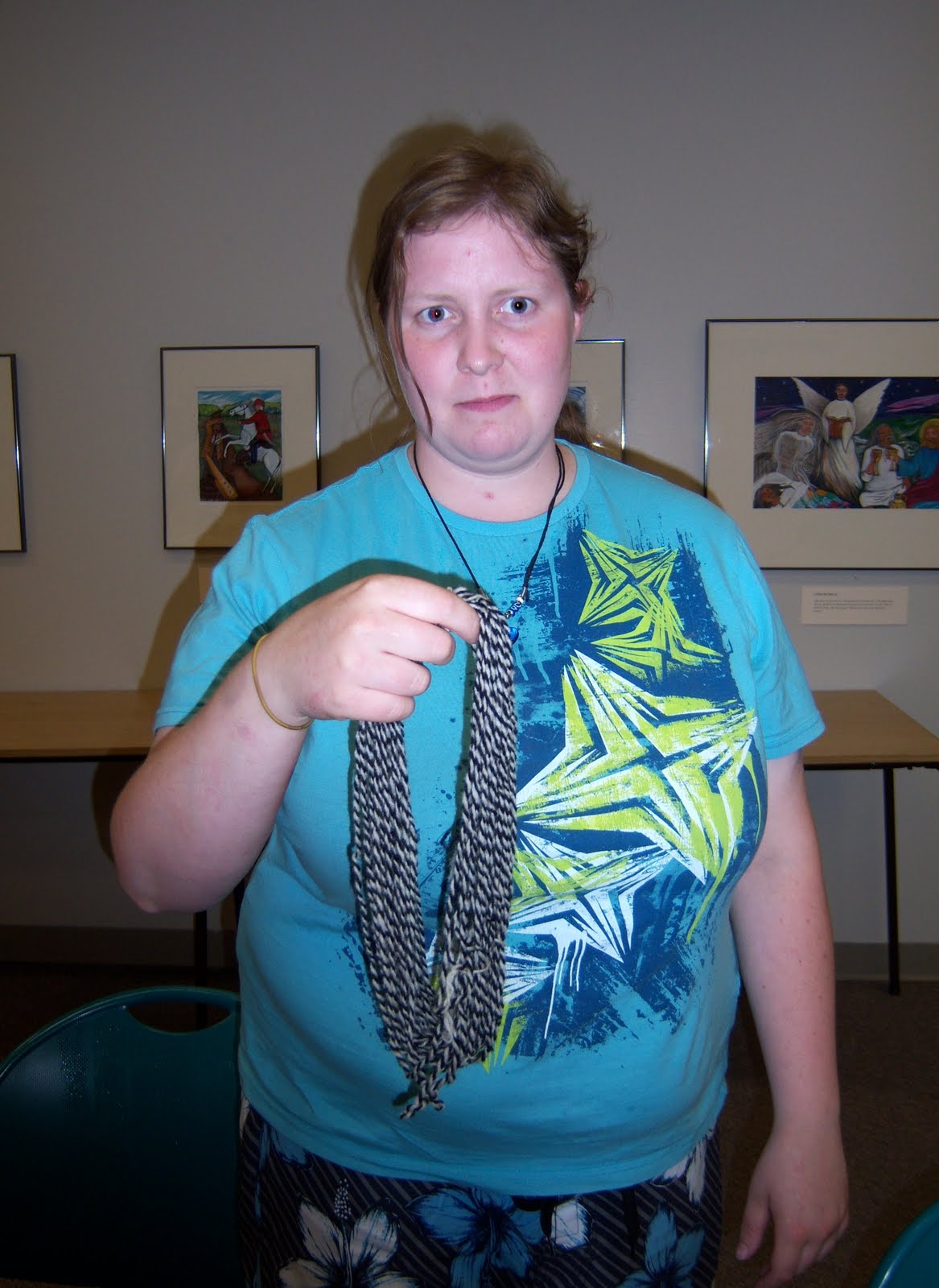
I taught two workshops for the public library and both were full. The second class was supposed to be the overflow from the first class's waiting list, but we managed to have more people in that class than in the original. By last night, 22 people from those classes were new spinners and we hope to bring more into the light because of the women who helped out at the Ex.
My workshops were hectic. I have only one photo of the first class:
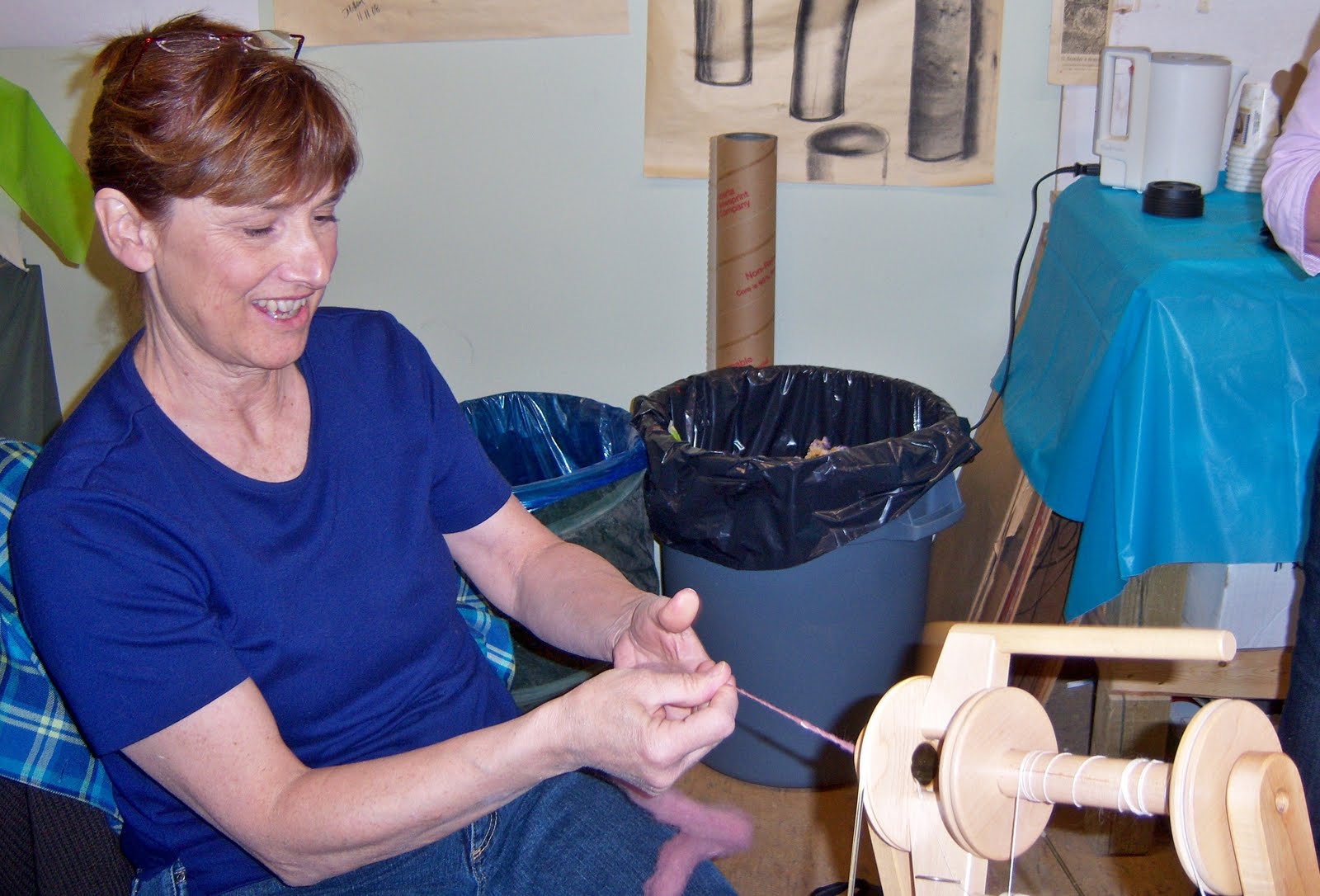
I forgot to take photographs of the second class learning to spin. The pictures here were taken last night, as the class practised plying:
And here they are, with their washed and whacked skeins. They did very well:
The spinning and meditation classes begin next week. So far, about fifteen people have expressed interest in attending one or more sessions, which amazes me (in a good way), considering that either practice alone is not that common here; doing both together could be seen as downright strange. I'm looking forward to the sessions.
If you want to be among fellow spinners or get yourself started, this is the place to be. Who says nothing ever happens here?!
I taught two workshops for the public library and both were full. The second class was supposed to be the overflow from the first class's waiting list, but we managed to have more people in that class than in the original. By last night, 22 people from those classes were new spinners and we hope to bring more into the light because of the women who helped out at the Ex.
My workshops were hectic. I have only one photo of the first class:
I forgot to take photographs of the second class learning to spin. The pictures here were taken last night, as the class practised plying:
And here they are, with their washed and whacked skeins. They did very well:
The spinning and meditation classes begin next week. So far, about fifteen people have expressed interest in attending one or more sessions, which amazes me (in a good way), considering that either practice alone is not that common here; doing both together could be seen as downright strange. I'm looking forward to the sessions.
If you want to be among fellow spinners or get yourself started, this is the place to be. Who says nothing ever happens here?!
Wednesday, 27 July 2011
Modern Times: Technology and Meditation Practice
I'm grateful for modern tools, especially when I have projects like this one:
That's 275 grams of a Corriedale batt, purchased at Fibre Week 2011, from Lynne Anderson of Knitopia. The entire batt fit on the bobbin on my Majacraft Pioneer wheel. I spun the heavy singles, more than 400 metres, in a few hours. It would have been a few days' work for me had I used a spindle.
I washed and dried the yarn on a PVC niddy noddy, something you'll try only once on a traditional wooden niddy noddy:
Although I am grateful for these things, I know that technology can overwhelm us, adding barriers to our experience of life. If we always listen to our music players when we walk the park, we miss the joyful sounds of birds, children, traffic, reality. It helps to strike a balance. Sometimes, we just need to sit.
Here's the thing: in many meditation traditions, sitting on your meditation cushion, simply sitting, being there, is seen as the only way to meditate. (Walking meditation is sometimes allowed as a secondary practice.) In the words of Chogyam Trungpa:
(Note: Chogyam Trungpa's life and teachings are interesting, to say the least. Sometimes we have to separate the words from the speaker!)
Sitting in meditation is a wonderful thing. It requires nothing more than a space, a cushion, time and you. So simple-not so easy.
Here's the other thing: this notion of just sitting is foreign to our Western minds (and bodies). Sometimes, the strangeness of it all leaves us unable to settle enough to find a beginning to our practice. We need to get ourselves to a studio, to focus on an object, to be mindful of something, at least at first. We need a support or supports. Once we steady ourselves, the supports can fall away. Until then, technology has some handy tools to guide us, in the form of iPod applications. The apps I use are free, through iTunes and are loaded on my iPod Touch. They come with a minimum (or no) advertising.
First up is zazen lite. This app has a simple timer, with a meditation bowl sound (2 choices) to mark the beginning and end of a session. There is the option of adding a mindfulness bell tone at intervals from 1 to 60 minutes during a session. (You have to hit "Okay" after the tone, which is annoying. Sometimes the mindfulness tone gets "stuck," and can only be fixed by ending the session. Also annoying.) I've not had problems timing a session or using the mindfulness bell on its own. For me, this app is a better option than setting a regular alarm or kitchen timer.
The most helpful meditation app I've used is pranayama lite. Pranayama is breath work; I find it difficult to maintain a regular rhythm without guidance. This app allows you to follow the breath in various rhythms and patterns. It has brief, clear instructions, settings for time, a beginner's level with 2 breath patterns and 5 levels of breath timing on each level and includes an automatic log which records each of your sessions.
There is also Insight Timer Lite, another meditation timer app and pocket Meditation Retreat, which has cute graphics and sounds, but which I haven't found helpful.
Although not meditation apps, I also use the free metronome app for my "Heart Like a Wheel" meditation, along with Buddha Board, which works in the same way as a physical Buddha Board does.
Test these tools for yourself. Let them guide you, but don't allow them to become another set of objects blocking your path. Use them sparingly.
Then go outside for a walk. Or sit and just breathe:
That's 275 grams of a Corriedale batt, purchased at Fibre Week 2011, from Lynne Anderson of Knitopia. The entire batt fit on the bobbin on my Majacraft Pioneer wheel. I spun the heavy singles, more than 400 metres, in a few hours. It would have been a few days' work for me had I used a spindle.
I washed and dried the yarn on a PVC niddy noddy, something you'll try only once on a traditional wooden niddy noddy:
Although I am grateful for these things, I know that technology can overwhelm us, adding barriers to our experience of life. If we always listen to our music players when we walk the park, we miss the joyful sounds of birds, children, traffic, reality. It helps to strike a balance. Sometimes, we just need to sit.
Here's the thing: in many meditation traditions, sitting on your meditation cushion, simply sitting, being there, is seen as the only way to meditate. (Walking meditation is sometimes allowed as a secondary practice.) In the words of Chogyam Trungpa:
It is a very interesting point that nobody has experienced that we can actually sit on a cushion without any purpose, none whatsoever. It is outrageous. Nobody would actually ever do that. . . .It's terrible-we would be wasting our time.
Now there's the point-wasting our time. Maybe that's a good one, wasting our time. Give time a rest. Let it be wasted. Create virgin time, uncontaminated time, time that hasn't been hassled by aggression, passion and speed. Let us create pure time. Sit and create pure time.
(The Path is the Goal, p. 9)
(Note: Chogyam Trungpa's life and teachings are interesting, to say the least. Sometimes we have to separate the words from the speaker!)
Sitting in meditation is a wonderful thing. It requires nothing more than a space, a cushion, time and you. So simple-not so easy.
Here's the other thing: this notion of just sitting is foreign to our Western minds (and bodies). Sometimes, the strangeness of it all leaves us unable to settle enough to find a beginning to our practice. We need to get ourselves to a studio, to focus on an object, to be mindful of something, at least at first. We need a support or supports. Once we steady ourselves, the supports can fall away. Until then, technology has some handy tools to guide us, in the form of iPod applications. The apps I use are free, through iTunes and are loaded on my iPod Touch. They come with a minimum (or no) advertising.
First up is zazen lite. This app has a simple timer, with a meditation bowl sound (2 choices) to mark the beginning and end of a session. There is the option of adding a mindfulness bell tone at intervals from 1 to 60 minutes during a session. (You have to hit "Okay" after the tone, which is annoying. Sometimes the mindfulness tone gets "stuck," and can only be fixed by ending the session. Also annoying.) I've not had problems timing a session or using the mindfulness bell on its own. For me, this app is a better option than setting a regular alarm or kitchen timer.
The most helpful meditation app I've used is pranayama lite. Pranayama is breath work; I find it difficult to maintain a regular rhythm without guidance. This app allows you to follow the breath in various rhythms and patterns. It has brief, clear instructions, settings for time, a beginner's level with 2 breath patterns and 5 levels of breath timing on each level and includes an automatic log which records each of your sessions.
There is also Insight Timer Lite, another meditation timer app and pocket Meditation Retreat, which has cute graphics and sounds, but which I haven't found helpful.
Although not meditation apps, I also use the free metronome app for my "Heart Like a Wheel" meditation, along with Buddha Board, which works in the same way as a physical Buddha Board does.
Test these tools for yourself. Let them guide you, but don't allow them to become another set of objects blocking your path. Use them sparingly.
Then go outside for a walk. Or sit and just breathe:
Sunday, 17 July 2011
Heat Wave!
It may not be hot enough to fry an egg on the pavement today, but I can assure you that it's hot enough to exhaust a dye pot. This morning, I set out this pot of alpaca, hot water and vinegar, added some Greener Shades dyes and left the whole thing on the barbeque, sans any heat except the sun:
I had to use a pot holder to remove the lid; the dye liquid is clear and those bits of dyed fibre on the ground have been washed with soap and well rinsed, with no dye run off. I might as well take advantage of the heat while I can.
While I was waiting on the pot, I finished my current Meditation Wrap. This one is knitted from handspun alpaca which was plied with a commercial lace weight alpaca, then overdyed in the yarn. The buttons were in my stash and I think they work well on this piece. They resemble the movement of clock hands and remind me of changes and the passage of time:
Yes, I photographed the thing draped over the dye pot. It's just too hot to even attempt a proper shoot. (It's probably too hot to be knitting and finishing alpaca, but, oh well. . . .)
I seem to be stuck in a 123 meditation rhythm. Every meditation wrap I've made lately has ended up being 48 inches long or 1.23 metres. That seems to be the amount of yarn I can stand to spin and ply before I lose focus and move to something else. Such short pieces call for some creative draping to make them wearable.
I didn't get any Tour de Fleece 2011 spinning done today, because I was also preparing for my workshops. Then again, I tested every one of the 25 spindles I made, so I was spinning something. This is the first box of spindles and fibre:
The rest of the spindles are waiting for the glue to dry before I pack them. 123 again: assemble, test, glue. The spindles are crude, made from toy wheels and yoyo's, in which Mr. DD kindly drilled centre holes for me. There is a shortage of quality wooden wheels around here and the spindles are rough and rather lighter in weight than I'd like. Some sanding, oil or paint will personalize them, but I'll leave that up to my students. If Peruvian spinners and other spinners around the globe can work with whittled sticks and wonky whorls, I'm sure my class will be able to coax yarn from these basic tools.
The day has been good, despite the heat. I've accomplished much; perhaps I'll spend the evening with a cold drink, a good book and, ah yes, a spindle and a bit of fibre.
Namaste.
I had to use a pot holder to remove the lid; the dye liquid is clear and those bits of dyed fibre on the ground have been washed with soap and well rinsed, with no dye run off. I might as well take advantage of the heat while I can.
While I was waiting on the pot, I finished my current Meditation Wrap. This one is knitted from handspun alpaca which was plied with a commercial lace weight alpaca, then overdyed in the yarn. The buttons were in my stash and I think they work well on this piece. They resemble the movement of clock hands and remind me of changes and the passage of time:
Yes, I photographed the thing draped over the dye pot. It's just too hot to even attempt a proper shoot. (It's probably too hot to be knitting and finishing alpaca, but, oh well. . . .)
I seem to be stuck in a 123 meditation rhythm. Every meditation wrap I've made lately has ended up being 48 inches long or 1.23 metres. That seems to be the amount of yarn I can stand to spin and ply before I lose focus and move to something else. Such short pieces call for some creative draping to make them wearable.
I didn't get any Tour de Fleece 2011 spinning done today, because I was also preparing for my workshops. Then again, I tested every one of the 25 spindles I made, so I was spinning something. This is the first box of spindles and fibre:
The rest of the spindles are waiting for the glue to dry before I pack them. 123 again: assemble, test, glue. The spindles are crude, made from toy wheels and yoyo's, in which Mr. DD kindly drilled centre holes for me. There is a shortage of quality wooden wheels around here and the spindles are rough and rather lighter in weight than I'd like. Some sanding, oil or paint will personalize them, but I'll leave that up to my students. If Peruvian spinners and other spinners around the globe can work with whittled sticks and wonky whorls, I'm sure my class will be able to coax yarn from these basic tools.
The day has been good, despite the heat. I've accomplished much; perhaps I'll spend the evening with a cold drink, a good book and, ah yes, a spindle and a bit of fibre.
Namaste.
Friday, 15 July 2011
Summer in the City
You know the saying, "My eyes are bigger than my stomach."? Some days I'm sure that my eyes are bigger than my eyes. These arrived yesterday, part of a book order that I hope to work through before summer ends:
That's a fair bit of reading on its own, but what really has my attention is this:
It's the new release by Deborah Robson and Carol Ekarius. The book has been out for a couple of months and I've been anxious to see it. I am not disappointed; this picks up where In Sheep's Clothing leaves off.
I expect The Fleece & Fiber Sourcebook to become a fibre worker's classic. The book is packed with information, including breed history, fleece characteristics, samples spun, knitted and woven. Turn to any page and you're likely to find something you didn't know, such as, in my case, the definition of "landrace." It's nicely laid out and beautifully photographed. Here's a sample of the entry for Blue Faced Leicester:
I'll end the evening with a glass of wine and some pleasant chatter with Mr. DD. I chatter, he listens or pretends to listen, which is just fine. Dragonflies the size of small birds hover across the back yard and there are plenty of brown bats this year, so perhaps this will help with mosquito control. There's a full moon to enjoy on what promises to be a clear, hot evening.
Summers are short here, so it's important to appreciate what we can. It's the ordinary beauty in simple, small things that bring me the most joy. Summer in the city-warm, breezy, bustling with life. Perfect.
That's a fair bit of reading on its own, but what really has my attention is this:
It's the new release by Deborah Robson and Carol Ekarius. The book has been out for a couple of months and I've been anxious to see it. I am not disappointed; this picks up where In Sheep's Clothing leaves off.
I expect The Fleece & Fiber Sourcebook to become a fibre worker's classic. The book is packed with information, including breed history, fleece characteristics, samples spun, knitted and woven. Turn to any page and you're likely to find something you didn't know, such as, in my case, the definition of "landrace." It's nicely laid out and beautifully photographed. Here's a sample of the entry for Blue Faced Leicester:
If you have an interest in protein fibres (silk isn't covered here), buy this book. You won't regret it. In addition to the wonderful contents, it will give you a work out-the book weighs a whopping 1.8 kilos/4 pounds!
Morris and Mr. DD headed out to the farm this morning, so I'm taking advantage of their absence and the summer heat to wash Romney and alpaca fleece. Fibre preparation drives both of them around the bend. I must admit, the smell wafting off the filthy alpaca is rather pungent:
I need to get this done-I have spindle spinning workshops (see page 14) to teach over the next four weeks and it's a bit much to ask beginners to work with dirty fibres:
I plan to finish another meditation wrap today, this one of hand spun alpaca plied with a commercial lace weight alpaca and over dyed red. It's warm work for +30C, but I've been sitting on the front step in the shade, knitting away and watching the world move along.
There is also my Tour de Fleece 2011 yarn to consider. Progress is slow, but I plied my linen/silk/cotton blend and I'm pleased with the texture. It's a strange, crunchy yarn; I'm waiting for it to tell me what it wants to be:
I'll end the evening with a glass of wine and some pleasant chatter with Mr. DD. I chatter, he listens or pretends to listen, which is just fine. Dragonflies the size of small birds hover across the back yard and there are plenty of brown bats this year, so perhaps this will help with mosquito control. There's a full moon to enjoy on what promises to be a clear, hot evening.
Summers are short here, so it's important to appreciate what we can. It's the ordinary beauty in simple, small things that bring me the most joy. Summer in the city-warm, breezy, bustling with life. Perfect.
Tuesday, 31 May 2011
Sockual Heeling
Okay, that's an atrocious pun, even for me, but it's cold and damp here and I need to maintain my sense of humour, no matter how badly I may express it. (Despite the cold, it's still a lovely day.):
On to the source of the bad punnery: Many years ago, I was fortunate enough to have a pair of my hand spun, hand knit socks included in SpinOff magazine. I was fairly new to sock knitting at the time, so I was full of great wisdom and words of advice. I was the only person included in the article who talked about darning socks and only to boast casually that "I had yet to darn a pair of my hand knit socks."
From that day on, the sock knitting goddesses had me in their sights. Every pair of socks I knit managed to gather holes in a very short space of time. Worse yet, the holes developed just beyond every reinforced area I worked, usually just past the heel or right at the heel turning. I darned, I patched, I cursed. I tried a few different things with my spinning and knitting, but returned to my habitual ways, with the same results-one definition of insanity.
Years later, along came Ravelry and its spinning groups. In threads and forums, great debates ensue as to what makes the perfect sock yarn. Some people insist that sock yarn must be 3 plies or more, while others claim that a singles can work just as well. "Merino and Blue-faced Leicester are great for socks," say some. "Not so," say others. "You must use Romney or Corriedale, or . . . ."
Last year, finally fed up with mending socks, I decided to run an experiment on my own sock yarns. I spun yarn for two pair of socks, plied and knit them at the same time, then subjected them to a year of regular wear, which for me, means hard use in shoes and boots year round. I machine wash my socks, but air dry them.
The yarn for both pairs were spindle spun Z. I spindle plied the yarn S for the striped pair and plied S with a wheel for the other pair. I don't count twists per inch, but I put a lot of twist into these yarns. ("Barbed wire" was my comment in my original notes.) The finished yarns average about 18 wpi (wraps per inch). The striped pair was knitted toe up on 2 mm needles, with a gauge of about 6 stitches per inch. The heathered pair was also knitted on 2 mm needles, top down, with a gauge of 6.5 stitches per inch. The striped pair was spun from commercial wool top (possibly Romney). The other yarns were 3 plied from a singles of mohair/wool/silk roving, a singles of wool roving and a singles of silk roving. I finished both yarns by washing them in hot and cold baths, giving them some serious whacking and drying them without blocking.
These are the socks as of May 2011. (I can't post a photo, for some reason, so please follow the link.) And these are the socks as of yesterday. Click and zoom if you want a closer view:
Both pair are wearing very well. The heathered pair pills slightly, due to the fibre preparation (roving) and the wool content. (I had thought that the pills were from the mohair, but closer inspection indicates that they come from the wool with some mohair bits, perhaps.) The striped pair looks like new, which is remarkable, given my track record. I attribute that to the fact that I put much more twist in spindle yarns than I do when I'm working on the wheel. (I think wheels are so quick that I get caught up in their speed and forget to pay attention to the yarn I'm making.) There are no signs of holes in heels or elsewhere. Both pairs feel firm, harder than most socks feel, but they're comfortable and not itchy. They're like cushions for the feet.
My conclusions from this small study are nothing earth-shaking. The "best" sock yarn depends upon fibre choice, preparation, spinning and plying techniques. If you want your socks to wear well, choose a tougher fibre, use commercial top or combed fibres, add plenty of twist when spinning and plying (Western spinners tend to under spin and ply their yarns), and knit the socks tightly.
Lessons learned:
1. When something isn't working, change it.
2. Experiment.
3. Pay attention.
4. Never, ever boast that you've yet to darn a pair of socks!
(If you're interested in more yarn experiments, head over to wanderskopos's blog. She's a great source of thoughtful and entertaining tests of hand spun yarns and wonderful knitting.)
On to the source of the bad punnery: Many years ago, I was fortunate enough to have a pair of my hand spun, hand knit socks included in SpinOff magazine. I was fairly new to sock knitting at the time, so I was full of great wisdom and words of advice. I was the only person included in the article who talked about darning socks and only to boast casually that "I had yet to darn a pair of my hand knit socks."
From that day on, the sock knitting goddesses had me in their sights. Every pair of socks I knit managed to gather holes in a very short space of time. Worse yet, the holes developed just beyond every reinforced area I worked, usually just past the heel or right at the heel turning. I darned, I patched, I cursed. I tried a few different things with my spinning and knitting, but returned to my habitual ways, with the same results-one definition of insanity.
Years later, along came Ravelry and its spinning groups. In threads and forums, great debates ensue as to what makes the perfect sock yarn. Some people insist that sock yarn must be 3 plies or more, while others claim that a singles can work just as well. "Merino and Blue-faced Leicester are great for socks," say some. "Not so," say others. "You must use Romney or Corriedale, or . . . ."
Last year, finally fed up with mending socks, I decided to run an experiment on my own sock yarns. I spun yarn for two pair of socks, plied and knit them at the same time, then subjected them to a year of regular wear, which for me, means hard use in shoes and boots year round. I machine wash my socks, but air dry them.
The yarn for both pairs were spindle spun Z. I spindle plied the yarn S for the striped pair and plied S with a wheel for the other pair. I don't count twists per inch, but I put a lot of twist into these yarns. ("Barbed wire" was my comment in my original notes.) The finished yarns average about 18 wpi (wraps per inch). The striped pair was knitted toe up on 2 mm needles, with a gauge of about 6 stitches per inch. The heathered pair was also knitted on 2 mm needles, top down, with a gauge of 6.5 stitches per inch. The striped pair was spun from commercial wool top (possibly Romney). The other yarns were 3 plied from a singles of mohair/wool/silk roving, a singles of wool roving and a singles of silk roving. I finished both yarns by washing them in hot and cold baths, giving them some serious whacking and drying them without blocking.
These are the socks as of May 2011. (I can't post a photo, for some reason, so please follow the link.) And these are the socks as of yesterday. Click and zoom if you want a closer view:
Both pair are wearing very well. The heathered pair pills slightly, due to the fibre preparation (roving) and the wool content. (I had thought that the pills were from the mohair, but closer inspection indicates that they come from the wool with some mohair bits, perhaps.) The striped pair looks like new, which is remarkable, given my track record. I attribute that to the fact that I put much more twist in spindle yarns than I do when I'm working on the wheel. (I think wheels are so quick that I get caught up in their speed and forget to pay attention to the yarn I'm making.) There are no signs of holes in heels or elsewhere. Both pairs feel firm, harder than most socks feel, but they're comfortable and not itchy. They're like cushions for the feet.
My conclusions from this small study are nothing earth-shaking. The "best" sock yarn depends upon fibre choice, preparation, spinning and plying techniques. If you want your socks to wear well, choose a tougher fibre, use commercial top or combed fibres, add plenty of twist when spinning and plying (Western spinners tend to under spin and ply their yarns), and knit the socks tightly.
Lessons learned:
1. When something isn't working, change it.
2. Experiment.
3. Pay attention.
4. Never, ever boast that you've yet to darn a pair of socks!
(If you're interested in more yarn experiments, head over to wanderskopos's blog. She's a great source of thoughtful and entertaining tests of hand spun yarns and wonderful knitting.)
Monday, 16 May 2011
Pleasant Valley Sunday
Dora Mushka wanted to do a practice run of the class she'll be teaching at Olds College, Alberta during Fibre Week. Susie, Lindsay, Sara and I packed up wheels, fibre and lunch and headed to Lumsden for a Sunday of spinning.
Along with Cheryl, Marybelle, Meegan and Wendy, we spent the day blending and spinning colour samples and designer/art yarns:
The class is designed for beginning spinners, so I assumed I'd be tagging along for the fun of it. "Pride goeth before a fall" and all that-I hadn't spun on my Louet Victoria in over a year and had forgotten just how fast that wheel spins. I spent the morning muttering under my breath as I produced a stack of overtwisted samples so energized that they could run marathons even after a good washing and whacking.
The afternoon went more smoothly. We moved to textured yarns, practising long draw, chain plying and spinning cables. We made garnetted, slubbed and wrapped yarns. I produced a tussah silk/wool/alpaca cabled yarn heavy enough to work as an (elegant) dog leash, a pretty blue wool yarn garnetted with spring colours, a vibrant soysilk/wool chain plied skein and a very loosely spun long draw singles of wool and alpaca:
I came home, tired but happy. After finishing my samples and leaving them to dry, I fulfilled my wifely duties by watching Survivor Finale and Vancouver in the hockey playoffs. I also completed this:
I knit the summer scarf from spindle spun wool/silk/alpaca fibres from Fleece Artist. The freeform crochet trim was worked in hand spun cochineal-dyed silk and hand spun emerald soysilk. The scarf looked incomplete until I added the trim, which reminded me to keep design in mind, even for such a simple thing. A bit of thoughtful planning can make the difference between producing a piece of cloth and making a unique accessory. There is a bit of asymmetry here, in the trim and its placement, just enough to make me smile when I remember the making of this piece:
The scarf and my samples are reminders of sunny, warm pleasant hours of spinning and friendship in the Qu'appelle Valley. What more could you ask of a day?
| Dora instructing with Lindsay and Susie in the background |
Along with Cheryl, Marybelle, Meegan and Wendy, we spent the day blending and spinning colour samples and designer/art yarns:
| That neon green background really highlights the yarns! |
The class is designed for beginning spinners, so I assumed I'd be tagging along for the fun of it. "Pride goeth before a fall" and all that-I hadn't spun on my Louet Victoria in over a year and had forgotten just how fast that wheel spins. I spent the morning muttering under my breath as I produced a stack of overtwisted samples so energized that they could run marathons even after a good washing and whacking.
The afternoon went more smoothly. We moved to textured yarns, practising long draw, chain plying and spinning cables. We made garnetted, slubbed and wrapped yarns. I produced a tussah silk/wool/alpaca cabled yarn heavy enough to work as an (elegant) dog leash, a pretty blue wool yarn garnetted with spring colours, a vibrant soysilk/wool chain plied skein and a very loosely spun long draw singles of wool and alpaca:
I came home, tired but happy. After finishing my samples and leaving them to dry, I fulfilled my wifely duties by watching Survivor Finale and Vancouver in the hockey playoffs. I also completed this:
I knit the summer scarf from spindle spun wool/silk/alpaca fibres from Fleece Artist. The freeform crochet trim was worked in hand spun cochineal-dyed silk and hand spun emerald soysilk. The scarf looked incomplete until I added the trim, which reminded me to keep design in mind, even for such a simple thing. A bit of thoughtful planning can make the difference between producing a piece of cloth and making a unique accessory. There is a bit of asymmetry here, in the trim and its placement, just enough to make me smile when I remember the making of this piece:
The scarf and my samples are reminders of sunny, warm pleasant hours of spinning and friendship in the Qu'appelle Valley. What more could you ask of a day?
| Sara, Marybelle and Wendy |
| Meegan |
| Sara |
Wednesday, 11 May 2011
What Do the Mountains Call Themselves? Musings on Fibre Terminology
Every summer when I was growing up, we'd pack up the car and head out on holiday to a park somewhere. Usually we'd stay in the province, but sometimes my parents would decide on an excursion through the Rockie mountains. On the drive, we'd be expected to learn the names of the most prominent peaks and their elevations. We'd stay in cabins along the way, taking long walks, noting the characteristics of flora and fauna on the trails.
Upon reflection, I realize that this was a way to preserve some semblance of sanity in a group of 7 children and 2 adults travelling thousands of miles on rough roads in a station wagon. (On shorter trips, we'd sometimes include my sister's godfather, "Uncle" Hugh, the family dog and my best friend. I've no idea how this was accomplished except that it involved a lack of seat belts, a stash of Archie and Superman comics and a now legendary blue plastic potty.)
I learned a lot while travelling this way-including a lifelong passion for solitude!-but it wasn't the facts and figures that stayed with me through time. In fact, my favourite remembered walk occurred in Waterton National Park, when my Dad and a family friend decide to give my Mom and her friend a break by taking the older children on a hike. A short, spontaneous walk with no particular agenda turned in an hours-long climb up the mountain trail and back. Two men set out with 4 or 5 small children in tow-I was the oldest at about 10 years old-no food, no water, no proper gear. As an adult, I shudder at the foolishness of the impulse, but what I remember of that day was a sense of wonder at the beauty of the trail, the variety of wildlife calmly noting our passing and the remarkable silence of small humans as we trudged up the trail. At the end of the path, we came to a glacier-fed mountain lake. I've never seen anything so clear or felt water so cold. The shear drop down the lake bed was a terrific danger, but Dad and Mr. O'G. watched carefully as we children lay on our bellies and caught rainbow trout with bits of string and a safety pin. I was mesmerized by the shimmering colours of the fish flashing through the lake ripples. Proudly, we tied up our catch in bandannas and headed back down the mountain to face the scolding Dad and Mr. O'G. received for scaring the wits out of our mothers. I've never enjoyed an outing or a meal of fish as I did that day.
I don't remember the specifics of what we saw on that walk. The names and details of mountains, plants and birds are long gone. Memories come in flashes, watercolours of what we experience. It's those larger pictures that give us joy.
| Clouds East of Kelowna |
On my recent trip to the mountains, I forgot to look for signs and notes of what humans have named. I saw mountain goats and sheep, antelope, coyotes, hosts of birds with blue tufted heads and huge neon yellow flowers pushing out of the marshes and ditches. The minutia of these things no longer concern me. Instead, I'm caught in the beauty of the moment, the flash of a creature (what was that?) as we drive past, the terrifying greatness of a collapsing rock face, streams of water racing down the mountains, along with snow, dirty white drifts of spring snow catching the sunlight in the mountain air.
What, you ask, does this have to do with spinning, fibres and the terminology we apply to it? Lately, I've been watching the growing Western fascination with spinning and the naming of techniques applied to the craft. I'm amused, because when I learned to spin, our terminology was more limited. We knew rolags, batts, roving, top and sliver. We understood woollen and worsted, long draw, Paula Simmons's "point of contact" and inch worm techniques. People like Mabel Ross, Peter Teal, and Allen Fannin promoted precision, measurement and industrial applications to hand spinning, but most spinners simply did what they needed to do to get the yarns they wanted. I soaked up as much knowledge as I could from books and other spinners. I was and remain in awe of friends who spin cobweb yarns to precise grist, but mostly, I just spin.
Now, I see intense discussions on long draw, supported long draw, American sliding long draw, short forward draw and many other terms. While I'm impressed with the earnest desire for knowledge, I'm caught off guard by spinners who are afraid to spin unless they know the "proper" terms for what they're doing, with precise details as to how to do them. They want to spin the right way, and, as a result, they sometimes get stuck before they get started. They worry about wasting fibres, wasting time, wasting money on a hobby. They question and question, forgetting that spinning, art and craft, is doing, not knowing.
Just as I sometimes missed the experience of our holiday adventures by focusing on the details of things, spinners who bind themselves too closely to the fine print can miss the wonders of the craft. (Feel free to insert the obligatory, "Can't see the forest for the trees" cliche here.) The terms we invented to help explain, clarify and order our actions can bury us in the details. We need to take time just to act, to do, to spin.
We don't know what the mountains call themselves. At heart, it doesn't matter what we call things or how we try to claim them in the naming. The beauty and the wonder of life, our actions and our presence in the world doesn't lie in how we describe them. Our joy comes from our interactions, experiences as they occur and our memories of them.
The next time you find yourself worrying about what fibre is best suited to the "sliding backwards while standing on one leg mid length draw," go sit at your wheel. Pick up your spindle. Just spin.
Or take a hike. Breathe and just BE. Hold the experience of your craft to your heart and enjoy the moment. Years from now, it will be what you best remember.
| Mountain Memories, May 2011, Ink and Watercolour |
Tuesday, 5 April 2011
Here Comes the Sun
Sun Salutations are cycles of specific yoga poses, exercised swiftly, gracefully, with flow. You do them in the early morning to greet and prepare for the awakening day. Sun Salutations are said to bring good health and good fortune; some say that a daily cycle of five salutations provides all the physical and mental discipline a yogi needs. At the summer solstice, many enthusiasts perform cycles of 108 Salutations to welcome the new season.
Sun Salutations are my downfall. I've never enjoyed doing them. They're hard work. They move more quickly than I think yoga poses should. They demand grace and attention-if your mind wanders, you lose track of the poses. They're the yoga equivalent of musical scales, repetitious to the point of boredom, but excellent for flexibility and discipline. Because of these things and because I believe in facing your fears and dislikes, I do Sun Salutation cycles every morning. Just not 108 of them.
When I began weaving, I was told that weaving twenty yards of plain cotton cloth was the best practice for learning to weave. Weaving this cloth would even your beat, straighten your edges and provide you with the discipline to become a production weaver. I wove those twenty yards of fabric. They became camisoles and tea towels and other useful items. I did not become a production weaver and I discovered that I was allergic to sewing, but I most certainly discovered discipline and focus.
I look at "plain vanilla" spinning and knitting as I did that weaving or my Sun Salutations. Putting your best efforts into a simple 2 ply yarn or a plain garter or seed stitch scarf looks easy, but in order to maintain consistency in the yarns, to keep your stitches nicely tensioned and your fabric even, you must focus. If you drift into other thoughts, you find your yarn drifting with them. You drop stitches and your fabric becomes uneven. You change all that by staying with what you are doing now.
My "plain vanilla" yarns and fabrics are far from perfect. I still enjoy my mindless spinning and knitting, but paying attention to the simplest projects has improved my focus. It helps me appreciate the beauty of simplicity and it disciplines me, mind and body, at times when the world seems to be getting away from me. Simple, rhythmic spinning and knitting is akin to those Sun Salutations I practise every day.
Fortunately, there's no requirement to work on 108 projects at once. I'm not quite there, yet.
Sun Salutations are my downfall. I've never enjoyed doing them. They're hard work. They move more quickly than I think yoga poses should. They demand grace and attention-if your mind wanders, you lose track of the poses. They're the yoga equivalent of musical scales, repetitious to the point of boredom, but excellent for flexibility and discipline. Because of these things and because I believe in facing your fears and dislikes, I do Sun Salutation cycles every morning. Just not 108 of them.
When I began weaving, I was told that weaving twenty yards of plain cotton cloth was the best practice for learning to weave. Weaving this cloth would even your beat, straighten your edges and provide you with the discipline to become a production weaver. I wove those twenty yards of fabric. They became camisoles and tea towels and other useful items. I did not become a production weaver and I discovered that I was allergic to sewing, but I most certainly discovered discipline and focus.
I look at "plain vanilla" spinning and knitting as I did that weaving or my Sun Salutations. Putting your best efforts into a simple 2 ply yarn or a plain garter or seed stitch scarf looks easy, but in order to maintain consistency in the yarns, to keep your stitches nicely tensioned and your fabric even, you must focus. If you drift into other thoughts, you find your yarn drifting with them. You drop stitches and your fabric becomes uneven. You change all that by staying with what you are doing now.
My "plain vanilla" yarns and fabrics are far from perfect. I still enjoy my mindless spinning and knitting, but paying attention to the simplest projects has improved my focus. It helps me appreciate the beauty of simplicity and it disciplines me, mind and body, at times when the world seems to be getting away from me. Simple, rhythmic spinning and knitting is akin to those Sun Salutations I practise every day.
Fortunately, there's no requirement to work on 108 projects at once. I'm not quite there, yet.
| A Basket of Simple Handspun Yarns in the Sun |
Thursday, 31 March 2011
Indulgence
Indulge: yield freely; take pleasure freely
Indulgence: privilege granted
(Concise OED)
Speaking of indulgences:
I ran into friends at Chapters yesterday, who pointed out this little kit, a steal at $2. It's an indulgence, completely frivolous. It made me smile. So, home it came with me.
This is my selection for my April spinning challenge:
Isn't she pretty? She's a top whorl "Deluxe" by Edward Tabachek, in Bird's Eye Maple with a Purpleheart shaft. She weighs 44 grams. Of all my spindles, she spun everything I tested-banana, cotton, qiviuq-as finely as I needed. Her weight allows me to spin a range of yarns, including bulky and designer creations.
You can browse Ed's site at http://www.mts.net/~tabachek/ I've been buying spindles from Ed since he began making them. Each spindle spins beautifully and brings me joy. So do Ed and his wife, Joanne, who tests every spindle. Ed's spindles can be a bit difficult to find these days, so I treasure mine.
I have a basket of stash fibres ready to go. I'm not stuck on any particular yarn or fibre, but that bag of qiviuq/silk I blended in 1991 has probably mellowed long enough. I haven't spun possum or banana; I have samples of both. I have some lovely batts blended by Sharon at Golden Willow Natural Fiber. They're calling out to become designer yarns. It's a start.
Any self-imposed challenge deserves a rule exception or two. After all, I don't want to become attached to non-attachment! This is my meditation spindle:
I'll continue to use it for formal sitting meditation. I'll also have to break my rule in spinning class, since we're moving to wheels this week. At home and around, exploring the possibilities of one spindle will be the theme.
This is Morris on his walk down the lane yesterday:
He was sniffing for gophers. Moments after this, we heard a squeak. Morris was right-there are a few hardy critters out and about.
Notice all the snow. At this time last year, there wasn't a bit of snow to be found. The ice was gone from Wascana Creek and the ducks were paddling around the shoreline. Yesterday, this was the view across the park to the creek:
Indulgence: privilege granted
(Concise OED)
Speaking of indulgences:
I ran into friends at Chapters yesterday, who pointed out this little kit, a steal at $2. It's an indulgence, completely frivolous. It made me smile. So, home it came with me.
This is my selection for my April spinning challenge:
Isn't she pretty? She's a top whorl "Deluxe" by Edward Tabachek, in Bird's Eye Maple with a Purpleheart shaft. She weighs 44 grams. Of all my spindles, she spun everything I tested-banana, cotton, qiviuq-as finely as I needed. Her weight allows me to spin a range of yarns, including bulky and designer creations.
You can browse Ed's site at http://www.mts.net/~tabachek/ I've been buying spindles from Ed since he began making them. Each spindle spins beautifully and brings me joy. So do Ed and his wife, Joanne, who tests every spindle. Ed's spindles can be a bit difficult to find these days, so I treasure mine.
I have a basket of stash fibres ready to go. I'm not stuck on any particular yarn or fibre, but that bag of qiviuq/silk I blended in 1991 has probably mellowed long enough. I haven't spun possum or banana; I have samples of both. I have some lovely batts blended by Sharon at Golden Willow Natural Fiber. They're calling out to become designer yarns. It's a start.
Any self-imposed challenge deserves a rule exception or two. After all, I don't want to become attached to non-attachment! This is my meditation spindle:
I'll continue to use it for formal sitting meditation. I'll also have to break my rule in spinning class, since we're moving to wheels this week. At home and around, exploring the possibilities of one spindle will be the theme.
This is Morris on his walk down the lane yesterday:
He was sniffing for gophers. Moments after this, we heard a squeak. Morris was right-there are a few hardy critters out and about.
Notice all the snow. At this time last year, there wasn't a bit of snow to be found. The ice was gone from Wascana Creek and the ducks were paddling around the shoreline. Yesterday, this was the view across the park to the creek:
Subscribe to:
Posts (Atom)