Study for Meditation Mat

Study for Meditation Mat
Handspun Tapestry Weaving

Sunday, 18 March 2012

It's a Wonderful World: Saving Our Food, Saving the Planet

Watch this:


Or really, watch any video featuring this woman.  She has many important things to tell us.


Saturday, 17 March 2012

Walk This Way

Sarah gave us a lesson in walking this week. "Bodhi Tree Finishing School," she calls it.  We positioned ourselves in Tadasana, then walked while learning to place our feet properly (heel to toe action, not up and down bouncing).  We swung our hips while pushing off from the back foot.  Then, we attempted all this while carrying 15 pound sandbags on our heads.  It was no small feat, I'll tell you.  (Yes, that horrid pun was intended.)

Sarah recommends wearing flat soled shoes, shoes that allow you to feel the ground under you, that don't restrict your feet, especially your toes.  Ideally, we would walk on grass and walk barefoot. This isn't always practical, but we can start by going barefoot in the house.

These puppies need a little work: try opening your toes so that you can see between each toe.  My weight isn't balanced; I shift over on my ankles which causes my knees to ache.  I also need to work at lifting my arches.


What on earth does this have to do with spinning?  A lot, actually.  The next time you sit at your wheel, pay attention to the way you move at your wheel.  Go barefoot or wear socks.  Stand in Tadasana before you sit; keep your back straight, but relaxed, with elbows in and shoulders down and relaxed.  Your chair should be firm, but comfortable, not so low that you are reaching up to the orifice, nor so high that your feet can't touch the ground without effort.

 
Check your alignment. Are your ankles stacked directly under your knees? If not, adjust your chair or wheel.

Place both feet evenly on the treadles.  (I'll assume double treadle here.  Use both feet on a single treadle wheel.)  Don't lift your feet up as you treadle, but think of treadling heel to toe, in a rocking motion.  I know a number of spinners who treadle with the outside edges of their feet or who shift their weight inwards on their ankles.  Keep your feet flat as you treadle and be aware of the weight distribution on them.  Do you feel balanced? You can treadle as quickly as you wish, but don't bounce and be aware of any discomfort in the ankles or the knees.  Take frequent breaks. 

If you're like me and get lost in the spinning, try setting a timer.  I have a meditation bell app that I can set to ring at intervals. That bell helps me to check in, to my posture and to my spinning.  Have I shifted from mindful spinning to habitual spinning?  Is my body still comfortable, but aligned?

Checking your posture as you spin will not only help you spin comfortably for longer sessions, it will turn your spinning activities into mindful awareness.  If you're paying attention, you'll spin more consistently, you'll catch problems early on and your yarn will improve.

The next time you sit at your wheel, take some time to sit before you spin.  Your body and your yarn will thank you.

And, thank you, Sarah!

Namaste.

It's time to switch to light weight socks.

Happy Saint Patrick's Day!  (In memory of my Dad.)

Thursday, 15 March 2012

Lifelines: Learning to Recognize Opportunities

Sometimes, it's a good thing to be strung along!


Lace knitters are familiar with lifelines, those bits of contrasting yarn we thread through our knitting to track patterns.  They mark a point in our knitting where we know our pattern and stitch count were correct, so that when mistakes happen, we can frog back to the lifeline, pick up the stitches and get knitting again.  You ignore a lifeline at your peril-refusing to use them may mean that an error in a project requires completely reknitting the project.  At the very least, it can mean you have some slow, laborious tinking (knitting back) to do.

There are lifelines in other events, too, although they may not be so obvious and may have a different purpose.  In times of crisis, when you're at a crossroad and unsure of the next step, lifelines are there to guide you, if you're ready to pay attention.

When I talk about lifelines, people often think that I'm going all "mystical moments" and "New Age-y," but lifelines are practical and usually come from very grounded sources. Friends and strangers  will reach out with opportunities for healing; you have only to accept their offerings. Lifelines differ from advice; people don't tell you what to do.  Rather, they will tell a story, perhaps without knowing that you are facing challenges, and you'll recognize yourself or your problem in the story.  They'll hand you a card to a place or an event which helped them or they'll speak of others who have successfully manoeuvred similar issues.  Sometimes, the lifeline is indirect, in the form of a poster you see on the street or an invitation on Facebook. 

I have to wait a while before I can take formal yoga teacher training, which left me wondering what to do in order to get a head start on the programme.  I'm taking several yoga classes, studying anatomy for hatha yoga, volunteer teaching on occasion, but I wasn't satisfied that I was on the right path.  Then the yoga studio posted an invitation to Colin's university class on yoga texts, teachers, and techniques.  There you have it-a lifeline.

I could have ignored the post.  I'd been away from school for decades.  The class is expensive; it involves a lot of reading, writing and learning to navigate formal education again.  Because it was offered outside of where I expected my training to occur, I could have missed the signal. Years of being open to signs and signals along my life path helped me to recognize an opportunity to grow and learn.  I grabbed the lifeline and away I went, into a class that's given me a philosophical grounding for my yoga practice and taught me just how little I actually know about yoga.

The wonderful thing about lifelines is that you don't have to do anything to find them.  You simply have to be open to possibilities in what is happening now.  We have to add lifelines to our knitting, but daily lifelines tend to be intuitive-you know them when you see them.  Once you learn to recognize them, they are everywhere.

The next time you think about ignoring a lifeline in that fancy lace shawl, think again.  Using a lifeline can't hurt and may save you from knitting calamity.  The next time an opportunity wanders across your path, wake up and pay attention.  It just might be the very thing you need to seize, the line that will guide you to the next step.

Namaste.

My shawl is finished: hand spun organic, natural coloured cotton in simple garter stitch with a lace edging.

Friday, 9 March 2012

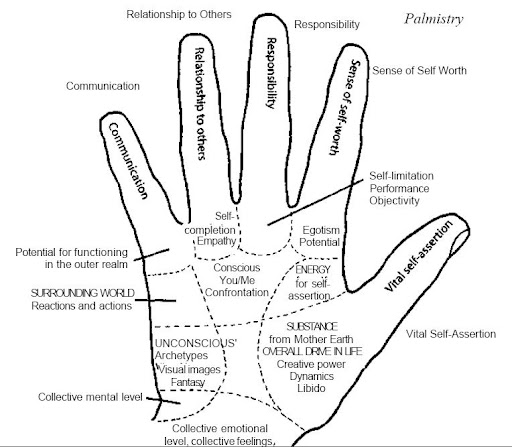
Give Her a Hand: Spinning and Mudras


Shuni Mudra, said to provide patience and discernment (Public Domain Images)


Do these hand gestures look familiar?  They are yoga mudras, gestures meant to control body energy, stimulate emotions, cure disorders and delight the gods.  Mudras have been used in many cultures, but most of them are familiar to us through yoga and Indian culture.  Depending upon which tradition you consult, the number of mudras (not all are hand gestures) varies. (108 is a popular number.)  We see them on Hindu and Buddhist images. Mudras are important traits of Kathak, a traditional Indian dance form or in meditation practices.

A spinner may be reminded of something else. These mudras are similar to the hand positions we use when spinning, for drafting fibres, guiding the thread or smoothing our yarn. Whether we realize it or not, we position our hands in gestures simulating mudras every time we spin. Since many of the mudras are believed to induce calm, patience and perserverance, is it any wonder than so many spinners discover a sense of relaxation when they sit at wheels or pick up spindles?

The next time you spin, pay attention to the way your hands move as they hold the fibres.  Investigate mudras and their possible benefits.  Explore a variety of mudras while you spin.  In true yoga fashion, Be a Scientist and seek to discover a new way of looking at your craft.

Namaste.

Relationship of yoga palmistry, mudra and their effects on the body, health and emotion.
(Public Domain Image)

Wednesday, 7 March 2012

Rest in Natural Great Peace: For Your Enjoyment


One of my yoga teachers used to play a mini-cd of this poem in our classes.  It's a wonderful recitation of a lovely poem by Nyoshul Ken Rinpoche.  Thanks, Rainie E, and thank you to Heather A, who reminded me again of its beauty.

Sunday, 4 March 2012

We Are One: Spinning to Calm the Roaring Spirit

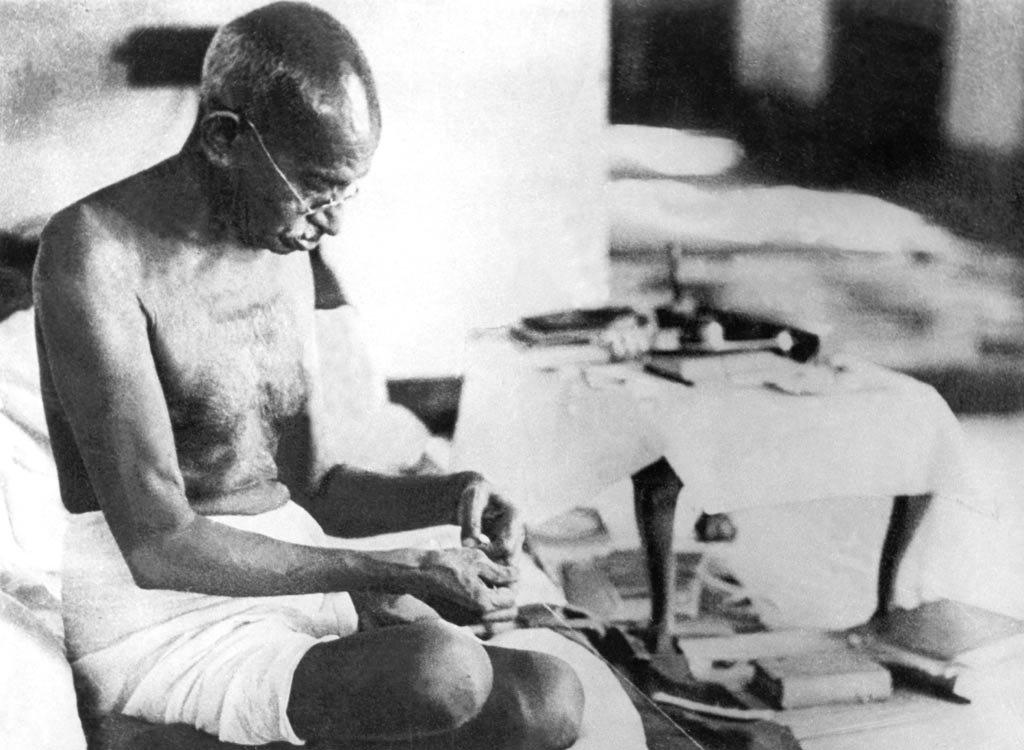
File:Gandhi spinning 1942.jpg
Gandhi spinning on a book charkha, 1942, Wikimedia Commons public domain photograph


What is it about spinning yarn that makes it so appealing as a meditation practice?  Why are spinners, some famous like Mohandas Gandhi, others unknown, drawn to the rhythm of the wheel or spindle?

Spinning, like meditation, is about doing, not about theory (although one can certainly study both spinning and meditation).  If you want to meditate, you must meditate; if you want to spin, you must practice with spindle or wheel and fibre.  No amount of reading or mere inquiry will make you a meditator/yogi or a spinner. 

Like meditation, spinning is simple, not easily done well.  Meditation is more than sitting, more than reflection and much more than watching or controlling your thoughts.  Only a few yogis achieve emptiness, or still mind.  Only by lengthy, sustained practice will a spinner develop muscle memory, control and deep understanding to the point where she becomes one with her yarn.

If you are a karmayogi, like Gandhi, spinning can be a means of practical service.  Although we need not concern ourselves with the yarn forming when we meditate, the resulting yarn can be used to cloth ourselves and others, to provide care and comfort to people suffering.

The mechanics of spinning yarn are ideally suited to meditation, the practice of staying in the Now, being with your thoughts, yet not being your thoughts.  As Gandhi discovered, the whir and clicking of the charkha soothes the mind and brings peace to the spirit. (In his autobiography, Gandhi speaks of how the sound of ashram women spinning helped heal him from illness.)  Both spinning and meditation can calm the roaring mind; angry, upset, we sit or spin or practice both.  After a time, the anger settles, the upset decreases and we no longer feel that we are our emotions.

Meditation helps release attachment, to habits, to emotions, to the human condition. When we practice unsupported long draw, as required when spinning cotton at the charkha, we must maintain focus and a light touch. Spinning cotton is a practical reminder that attachment brings suffering-if our attention wanders, if we clutch the fibres, our yarn becomes sloppy or breaks.

When we spin, we are connected to a larger self, the part of us that is about spirit and community.  Spinning connects us to all spinners who have gone before us, who made possible the cloth that allowed humans to move across the planet, to stay alive.  Spinning connects us to communities here,  through shared experiences with local, national or international spinning circles. Like meditation, spinning can relieve us, if only for a moment, of our sense of being alone, lost in a sea of constant changes. In this way, spinning provides us with a tool to connect with the larger self that is found in meditation, whether we see that larger self as something within us or as a link to a universal whole.

The next time you sit down at your wheel or pick up your spindle, try spinning in meditative reflection.  Stay present (i.e., don't "zone out" or concern yourself with what the yarn will become) and focus on what is happening as your hands move, the fibre changes, the yarn forms.  Pay attention, the way you would were you meditating on a candle flame, and see if the rhythm of the spinning whorl as meditation/yoga practice helps to soothe the chatter of the whirling mind.

File:Gandhi spinning.jpg
Mohandas Gandhi spinning, late 1920's, Wikimedia Commons, public domain photograph

Friday, 2 March 2012

The Circle Game Continues: More Research on Gandhi and His Spinning

Gandhi at his spinning wheel in 1929.  Public domain image.


I'm gathering information for the major research paper which is a requirement in my Yoga Studies class.  While Gandhi's reasons for choosing spinning in his political goals are reasonably well known, it's less clear why he thought cotton spinning was an excellent tool for his spiritual practice, although he states its importance often in his writing.  Since hand spinning is no longer a common activity, let alone combined with meditation and spirituality, finding written material on the subject is an adventure.

Here are a few things I've discovered about Mohandas and his spinning:
  • Early in his career, Gandhi made the common mistake of confusing "spinning" with "weaving."  ("Tantra" means "loom" in Sanskrit; "sutra" means "thread," but is also used to denote instructive ideas, as in the Yoga Sutra. Perhaps some of the confusion stemmed from this?)
  • Gandhi learned to spin later in life, sometime after 1917, when he was approaching his fifties.  By that time, spinning was little known in India and the process of finding a spinning wheel was difficult.  Gandhi was assisted in his endeavours by a widow named Gangabehn Majmundar, who after long searching, found him a wheel in Vijapur.  It was Gangabehn who helped people in the Baroda State dust off their unused wheels and begin spinning again, when one of Gandhi's followers, Umar Sobani, found a steady supply of cotton slivers to feed the wheels.
  • Gandhi promoted the use of takhlis, the small metal spindle used for fine cotton spinning, as well as the charkha. 
  • Gandhi was attracted to the spinning wheel both as spiritual symbol and as a mechanical device. "Charkha/cakra" means "wheel;" its imagery is connected to the Sun, a powerful object and symbol of worship in Hindu tradition.  As known to every spinner who has moved beyond the basics of spinning, the spinning wheel produces a rhythm and sound conducive to calming meditative states; Gandhi felt the lure of the wheel, too.
  • Gandhi is credited with modernizing the Indian charkha, but it is difficult to say how the modern book charkha came into existence.  Gandhi promoted several design contests for wheel modifications.  He made it clear that a modern wheel should be light, portable, easily made from inexpensive materials affordable to the poorest Indian, but exactly who designed the book charkha and when it came into use is unclear.  There are photographs of both Mohandas and his wife spinning; in most cases, the pictures I have seen show them spinning at a traditional wheel, although they certainly used the book charkha.
  • In the famous 1946 photograph by Margaret Bourke-White of Gandhi at his wheel, Gandhi is not, as is often thought, actually spinning.  Rather, he is reading, with the traditional charkha in front of him. Among other things, the photograph symbolizes Gandhi' s commitment to education and work.
Almost finished: my shawl spun from organic and naturally coloured cotton.

    Brass takhli spindles, a spindle bowl, my woven cotton fabric (commercial cotton warp), skeins of cotton singles and unginned cotton (my favourite cotton spinning preparation)