Study for Meditation Mat

Study for Meditation Mat
Handspun Tapestry Weaving
Showing posts with label meditation. Show all posts

Sunday, 25 March 2012

The Real Thing: On Being "Genuine"

On Friday, Colin asked us to ponder what constitutes "genuine yoga."  Now, I love to "ponder." In fact, some would call me "ponderous," so I've been thinking about this question for some time.  I've discussed what I look for in a yoga teacher (here) as well as what I think "real" yoga should be (here).

It's always easy to discover what you expect from others.  What I haven't thought about much is what I expect from myself as a student-if yoga and its teachers have duties to their pupils, do I have any responsibilities to ensure sincerity in my practice?

The answer is, as always, "It depends."  If I'm following something for simple enjoyment and interest, then I may not feel the need for in depth study, or even to take that topic very seriously.  Long ago, I may have been content to go to a yoga class and simply practice asanas.  Moving my body, stretching and making the effort to stay healthy are fine things just on their own. As I've continued to practice, I've discovered that I'm hoping to accomplish something more with my yoga/meditation and fibre arts.  If I want to incorporate something as a life practice, or spiritual pursuit, then it's reasonable to expect that my efforts will go a little deeper. 

With that in mind, I'd like to offer some ideas on what a student should bring to her studies.  (Note to my students: Do not be afraid.  I do not have these expectations for anyone else.  I'm grateful just to have you attend classes!)

  • A serious student owes it to herself and her teacher to take responsibility for the choices she makes.  Before I jump into something, I might do some preliminary research on my subject and its instructors.  Do these courses and their teachers seem to fit my interests and learning style?  Will they do me more harm than good?  This is a very practical consideration: I can get physically, or less commonly, mentally or emotionally hurt in a yoga class if the teacher doesn't consider individual capabilities, pushes too hard or doesn't listen, but the same thing can happen if I don't listen to my body, know my strengths and weaknesses and pay attention.  Teachers are not mind readers. I need to tell them what they need to know. Physical limits are not as serious in a fibre class, but they are there.  If a particular spinning technique hurts, then I need to let that be known.  A good teacher will find a modification, but I need to tell her that modifications are necessary. I also need to remember that one teacher does not fit all.  Sometimes, I'm the wrong student for a particular instructor; sometimes, I will have to move on.
  • Conversely, I don't need to cover all bases before taking a chance.  Once in a while,it's good just to grab that lifeline and jump.  If something crosses my path, I tend to take that as a sign to go for it.  As a student, I need to have some sense of adventure.
  • As a serious student, I should be open to the possibility that I have much to learn.  This is a particular problem if I've been studying something for any length of time: I may not recognize just how little I know.  Sometimes, I do know more than my teacher, but that doesn't mean she doesn't have something to teach me.  I thought I knew something about yoga; taking this university class taught me how little I do know, which is the most valuable lesson I've taken from the class (and there are many lessons I took from the class).  If I thought I knew everything there is to know about spinning or knitting, I'd never be able to take another fibre class.  Where's the fun in that?
  • Along with admitting my lack of knowledge, I need to listen.  I have a problem with listening well-I tend to anticipate answers; I want to let people know what I know about a topic and I fail to hear what others say.  If I don't practice listening attention, I miss out on what others have to offer.
  • Most importantly, if I want to develop a genuine practice, I need to do the work. No excuses.  Yes, life gets in the way of my goals sometimes. When it does, I have to find a way around or through the obstacles.  If I want to go below the surface of a subject, I must do what is asked of me, as best I can.  I need to work to my capacity or safely beyond it. So, I do that reading, those papers, that particular knitting technique or drafting style.  Then, I do more.  Being a serious student doesn't just mean doing the work asked.  It means I must do that work and then whatever else I need to do to satisfy my curiosity.  If I'm lucky, I'll never solve all the mysteries or find all the answers to my questions.
If I want to find "genuine" yoga/meditation/fibre arts, I have no further to look than within myself.  I'm a true believer in the old idea that, "When you are ready, the teacher will appear."  It wasn't until I decided that my attitude towards a subject, any subject, was the key to discovering what I needed to learn that possibilities began to appear everywhere. 

Openheartedness is the sprouting seed.  Once we open our hearts, we allow roots to grow, nourishing our interests and providing multiple branches to support those interests. If we do that, our practice will be strong, sincere and genuine.

Namaste.


Saturday, 17 March 2012

Walk This Way

Sarah gave us a lesson in walking this week. "Bodhi Tree Finishing School," she calls it.  We positioned ourselves in Tadasana, then walked while learning to place our feet properly (heel to toe action, not up and down bouncing).  We swung our hips while pushing off from the back foot.  Then, we attempted all this while carrying 15 pound sandbags on our heads.  It was no small feat, I'll tell you.  (Yes, that horrid pun was intended.)

Sarah recommends wearing flat soled shoes, shoes that allow you to feel the ground under you, that don't restrict your feet, especially your toes.  Ideally, we would walk on grass and walk barefoot. This isn't always practical, but we can start by going barefoot in the house.

These puppies need a little work: try opening your toes so that you can see between each toe.  My weight isn't balanced; I shift over on my ankles which causes my knees to ache.  I also need to work at lifting my arches.


What on earth does this have to do with spinning?  A lot, actually.  The next time you sit at your wheel, pay attention to the way you move at your wheel.  Go barefoot or wear socks.  Stand in Tadasana before you sit; keep your back straight, but relaxed, with elbows in and shoulders down and relaxed.  Your chair should be firm, but comfortable, not so low that you are reaching up to the orifice, nor so high that your feet can't touch the ground without effort.

 
Check your alignment. Are your ankles stacked directly under your knees? If not, adjust your chair or wheel.

Place both feet evenly on the treadles.  (I'll assume double treadle here.  Use both feet on a single treadle wheel.)  Don't lift your feet up as you treadle, but think of treadling heel to toe, in a rocking motion.  I know a number of spinners who treadle with the outside edges of their feet or who shift their weight inwards on their ankles.  Keep your feet flat as you treadle and be aware of the weight distribution on them.  Do you feel balanced? You can treadle as quickly as you wish, but don't bounce and be aware of any discomfort in the ankles or the knees.  Take frequent breaks. 

If you're like me and get lost in the spinning, try setting a timer.  I have a meditation bell app that I can set to ring at intervals. That bell helps me to check in, to my posture and to my spinning.  Have I shifted from mindful spinning to habitual spinning?  Is my body still comfortable, but aligned?

Checking your posture as you spin will not only help you spin comfortably for longer sessions, it will turn your spinning activities into mindful awareness.  If you're paying attention, you'll spin more consistently, you'll catch problems early on and your yarn will improve.

The next time you sit at your wheel, take some time to sit before you spin.  Your body and your yarn will thank you.

And, thank you, Sarah!

Namaste.

It's time to switch to light weight socks.

Happy Saint Patrick's Day!  (In memory of my Dad.)

Wednesday, 7 March 2012

Rest in Natural Great Peace: For Your Enjoyment


One of my yoga teachers used to play a mini-cd of this poem in our classes.  It's a wonderful recitation of a lovely poem by Nyoshul Ken Rinpoche.  Thanks, Rainie E, and thank you to Heather A, who reminded me again of its beauty.

Sunday, 4 March 2012

We Are One: Spinning to Calm the Roaring Spirit

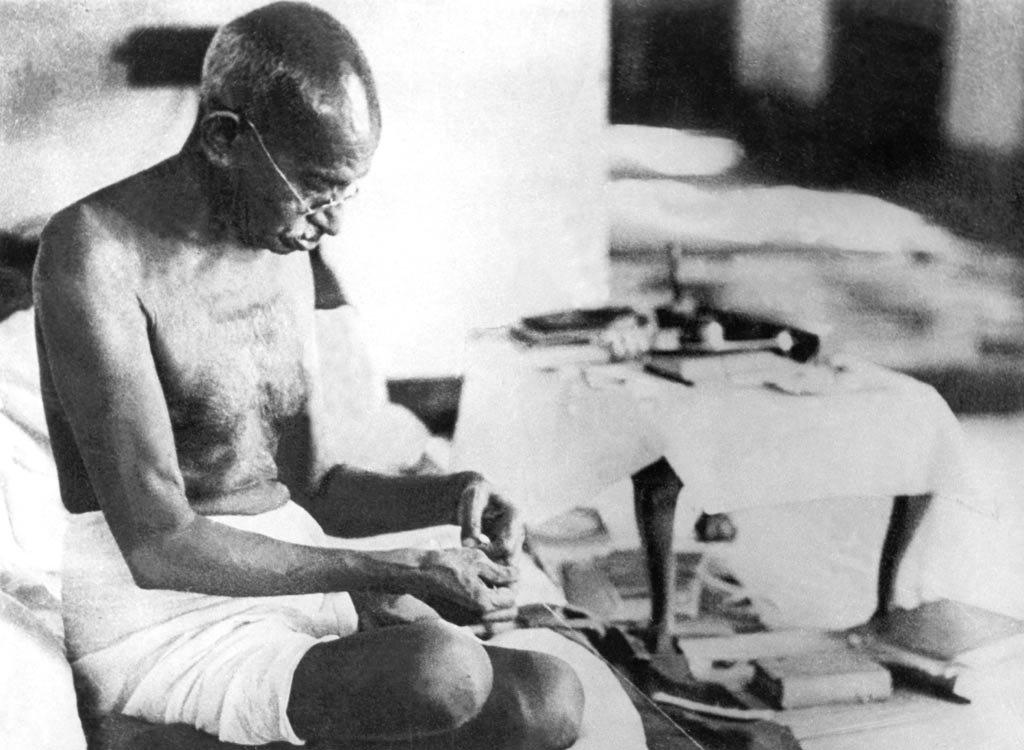
File:Gandhi spinning 1942.jpg
Gandhi spinning on a book charkha, 1942, Wikimedia Commons public domain photograph


What is it about spinning yarn that makes it so appealing as a meditation practice?  Why are spinners, some famous like Mohandas Gandhi, others unknown, drawn to the rhythm of the wheel or spindle?

Spinning, like meditation, is about doing, not about theory (although one can certainly study both spinning and meditation).  If you want to meditate, you must meditate; if you want to spin, you must practice with spindle or wheel and fibre.  No amount of reading or mere inquiry will make you a meditator/yogi or a spinner. 

Like meditation, spinning is simple, not easily done well.  Meditation is more than sitting, more than reflection and much more than watching or controlling your thoughts.  Only a few yogis achieve emptiness, or still mind.  Only by lengthy, sustained practice will a spinner develop muscle memory, control and deep understanding to the point where she becomes one with her yarn.

If you are a karmayogi, like Gandhi, spinning can be a means of practical service.  Although we need not concern ourselves with the yarn forming when we meditate, the resulting yarn can be used to cloth ourselves and others, to provide care and comfort to people suffering.

The mechanics of spinning yarn are ideally suited to meditation, the practice of staying in the Now, being with your thoughts, yet not being your thoughts.  As Gandhi discovered, the whir and clicking of the charkha soothes the mind and brings peace to the spirit. (In his autobiography, Gandhi speaks of how the sound of ashram women spinning helped heal him from illness.)  Both spinning and meditation can calm the roaring mind; angry, upset, we sit or spin or practice both.  After a time, the anger settles, the upset decreases and we no longer feel that we are our emotions.

Meditation helps release attachment, to habits, to emotions, to the human condition. When we practice unsupported long draw, as required when spinning cotton at the charkha, we must maintain focus and a light touch. Spinning cotton is a practical reminder that attachment brings suffering-if our attention wanders, if we clutch the fibres, our yarn becomes sloppy or breaks.

When we spin, we are connected to a larger self, the part of us that is about spirit and community.  Spinning connects us to all spinners who have gone before us, who made possible the cloth that allowed humans to move across the planet, to stay alive.  Spinning connects us to communities here,  through shared experiences with local, national or international spinning circles. Like meditation, spinning can relieve us, if only for a moment, of our sense of being alone, lost in a sea of constant changes. In this way, spinning provides us with a tool to connect with the larger self that is found in meditation, whether we see that larger self as something within us or as a link to a universal whole.

The next time you sit down at your wheel or pick up your spindle, try spinning in meditative reflection.  Stay present (i.e., don't "zone out" or concern yourself with what the yarn will become) and focus on what is happening as your hands move, the fibre changes, the yarn forms.  Pay attention, the way you would were you meditating on a candle flame, and see if the rhythm of the spinning whorl as meditation/yoga practice helps to soothe the chatter of the whirling mind.

File:Gandhi spinning.jpg
Mohandas Gandhi spinning, late 1920's, Wikimedia Commons, public domain photograph

Thursday, 19 January 2012

Higher Part 3: Fibre Arts Meditation and Moving Inward

We sit on our cushions.  We meditate.  We spin.  We knit.  We're not looking for particular results, but it's in our nature to wonder: does any of this have practical benefits?

Fibre artists donate their time, efforts and money to many worthy causes.  Whether it be to premature infants, people struck by disaster or hapless penguins, crafters are always willing to donate hats, blankets, sweaters, whatever is needed, when they are needed.  The action can be political, too -  as witnessed by knitting support for the Occupy Movement.

Do more subtle changes occur as a result of our practice?  Given time, yoga and mindfulness can provide a shift in our perspective, a change in thought that may deepen our connections to other beings and the planet.

You won't be far along your spinning path before you realize the commitment and skill required to spin a good piece of string.  Spinning gives us new respect for the materials we use.  Instead of  always reaching for yarn that represents the best bargain for us, we may begin to think about the processes involved in supplying that yarn.  Just how can the $5 skein of yarn from across the world provide a living wage for its makers?  Would we be willing to make $5 yarn, even if we kept all the profits (never mind the numerous middlemen set to take their cut)?  Would it make more sense to buy locally?

If these questions arise, they are more likely to manifest slowly, subconsciously, rather than hit you over the head with moral dilemma.  I knit dozens of pairs of socks before I realized that I hadn't purchased myself a pair of Big Box Store socks for years.  Now that I understand the costs required to produce a pair of $3 socks and the likelihood that sock producers see very little return for their efforts, I no longer have the urge to buy cheap socks.  Apart from the ethical issues, sock knitting provides meditative moments in my busy days.  Besides, hand knit socks feel and wear better than inexpensive house brand footwear.

A word of caution: becoming aware of these connections among sentient beings and deciding on a course of action isn't a license for self-satisfaction or judgment.  I may no longer buy BBS socks, but I do stock up on winter tights every few years and I refuse to knit my own underwear.  We also never know the effects our actions have on others.  I may believe that knitting my own socks will contribute to the decline of sweatshops and child labour, when what I'm really doing is depriving someone of desperately needed income, no matter what the working conditions.

All we can do is live our lives in good faith and hope that we leave the planet a bit better, or at least, not make things worse.  Meditation practice brings us to awareness and connection.  It's a good place to start.

Namaste.

This week's knitting: working through my sock yarn stash

Thursday, 12 January 2012

Higher: On the Subject of Lofty Spinning

Gandhian Philosophy of the Spinning Wheel


School is keeping me busy.  I'd forgotten how much time and effort is involved to study and participate effectively, even for a single class. 

In addition, I was asked to take over a Relax and Renew yoga class.  Although I've practised yoga for years and taught for a long time, I've never taught a yoga class.   I wasn't tapped for my brilliant asanas and instructional skills.  I was the only one available to teach this class and I was looking for a way to thank the studio for all it's given me.  So, in I leaped.

My experiences have me thinking: how did I get here?  At what point did yoga, meditation and fibre arts become my life?  How on earth did I decide to combine my spinning with meditation practice?  Why do this?

If the combination of sitting and string seems "weird" (as some so straightforwardly put it), the idea of combining the mundane with the spiritual has a long tradition, from spinning for magic and ceremonial purposes down to "The Man" himself - Mohandas K. Gandhi.

Even non-spinners know the association between Gandhi and the spinning wheel, especially the charkha.  Lesser known is the philosophy which led to Gandhi's commitment to the wheel and cotton spinning.  There is not a lot of popular literature available on Gandhi and spinning, but while I was searching for references to Gandhi and karmayoga (loosely meaning "yoga through action"), I came across a reference to a gem of a book, the cover of which is pictured above.  (I have no idea why the image insists on separating itself from the body of my post.  Sometimes the mysterious ways of the cyberworld defeat me.)

The book is apparently unavailable for purchase, but I've been able to read excerpts on line.  So far, it's the best synthesis I've found of Gandhi's philosophy and his commitment to spinning both as meditation and as a vehicle for the greater good.  The author, Mohit Chakrabarti, nicely sums up Gandhi's choice of cotton spinning as symbol and action:


Why does Gandhi take recourse to the spinning wheel when discipline is essentially a training of the mind which can be well-exercised by means of other media of exercise of the mind?  The answer, as Gandhi advocates, is quite clear.  He is quite aware of the two types of disciplines necessary for the growth and development of being viz., inward and outward.  Quite unlike other humanists, Gandhi launches his programme for introducing the spinning wheel to serve the twin purposes of inward discipline while undergoing outer discipline or discipline in the extrinsic form at the same time. (p. 11)
So there you have it: spinning, with its steady rhythm and repetitive movement is a means to draw us inward.  In the process, we make a product which can be used practically and symbolically.  In Gandhi's case, cotton spinning helped end British colonial rule in India.

Now, I don't have such lofty goals, nor do I fancy myself walking in Gandhi's footsteps.  The thing is, Gandhi was not "Mahatma" until others made him so.  Gandhi was no more or less that human, with all the faults and contradictions attached to the human condition.  Sometimes quick to anger, he was by his own admission, often unkind, especially to his wife.  Gandhi was a product of his time and culture, as are we all.  Yet he found a way to transcend his faults.  He used simple means to change his world, inch by inch, thread by thread, with a constant return to mindfulness and right practice.

Gandhi's devotion to spinning and the changes he effected is a practice worth exploring.  I'd like to go there for a while and see if I can apply some of Gandhi's ideas and actions to my life.

Let's go higher and see where we land.

Namaste.

Tuesday, 3 January 2012

The Wall: Learning to Cope With Negative Experiences

I lost my voice last week.  A wicked virus signalled its arrival by leaving me exhausted on Christmas Eve.  I made it through Christmas Day, but woke up on Boxing Day, unable to make a sound.  Although Mr. DD was convinced I was hoarse from too much talking the night before, the next few hours proved that something else was happening.

I spent the next week in bed, pretty much.  Boxing Day gatherings, a family dinner, New Year's Eve and New Year's Day celebrations left me behind.  The children departed and the world kept moving without much of a contribution from me.

On top of this, a good friend is having a rough time and I am powerless to do anything but send good thoughts while he struggles.  Any words of sympathy I can extend won't help him ease his burden. 

It was all a bit much.  The next thing I knew, my literary "voice" had followed my literal voice.  Blogging, journalling, even simple thank you notes were beyond my capabilities. Meditation, knitting and spinning were out of the question.


What do we do when the world overwhelms us?  The traditional advice is to "buck up, look on the bright side."  Things will change and we know that, but when we're sinking in an ocean of tough experience, false cheer can seem more of an anchor than a lifeboat.

We experience emotions as physical responses to events, real or perceived. Objectively, anger and sorrow are as valid emotionally as are happiness and joy.  It's our labelling of the emotion and our reaction  and attachment to it that dictate whether our experience is positive or negative.  Rather than trying to play "Pollyanna" with unpleasant events, we can try to experience the event as it is, rather than how we feel it to be.

In other words, if we're sick, then we should be sick, fully and completely, allowing ourselves the time to experience what is happening, allowing ourselves time to heal, without fighting what is or being angry that we are not experiencing something else.  If we can't knit or spin, then we need to experience the reality of not spinning or knitting. Don't sulk because you'd rather be spinning than doing housework, studying, or being ill.  Just abide in whatever you are experiencing in this moment.

Simple, yes.  Difficult, yes, but if you focus your energy into being ill, you may find that the time you spend in illness before the next change occurs will be shorter than if you wasted energy fighting the inevitable.

It was only when I gave up, admitted that I had to stop moving for a while, and took to my sickbed fully, that I began to gather enough resources to feel better.  I missed a lot of fun last week, but at least I'm not suffering from anger or resentment from missing out.  I'm feeling much better now.

Sometimes, life sucks and we just want to punch a wall. That's okay - we may find that punching through that wall is what we need to move through our pain. The next time life deals you a blow and you feel like punching a wall, go ahead.  Just remember that some actions are better done in mind only!

Namaste.

Friday, 16 December 2011

Inside: On the Value of Retreat

I have a friend who goes on retreat every year, between December 20 and January.  She cleans the house, stocks the fridge and pantry and organizes her outside workload.  Then, at the dawn of the Winter Solstice, she unplugs her computer and her television, turns off her phone and stays inside.  From the Solstice to the New Year, K remains alone, in silence, interacting only with her thoughts, in an effort to reconnect with her self.  (Yes, the cat gets fed.)

In this winter season, we get caught up in the frenzy of cooking, cleaning, shopping, knitting and social activities. Many of us find ourselves drained of energy and patience.  Rather than enjoying all the action, I notice that I'm becoming more short-tempered, frustrated and, well, just downright touchy over matters that really aren't that important.  Breath work, asanas and meditation aren't enough to keep me balanced.  And so, I retreat.

We may not be able to lock ourselves away for a week or two, but when you're overwhelmed by the energy around you, take a few moments to move inwards and cherish yourself.  Head to your fibre room, your meditation space, close the door and sit for a while.  Put aside that holiday knitting for a few hours.  Knit, spin, weave or engage in fibre work solely for your own enjoyment.

Most importantly, stop talking.   We tell ourselves that words explain, communicate and heal, but sometimes, especially when we are stressed, we use words as weapons or as a means to fill space.  We are incapable of listening, of hearing what others tell us or the messages of our inner voices.

This month, consider giving yourself what may be the most precious gift, the gift of silence.  A few moments, hours, a day or two may be all you need to focus your scattered energy, and appreciate the wonders around you.

File:Om hindu.jpg
"OM" from Wikimedia Commons


Wednesday, 14 December 2011

Rise Up: Ya Needa Break!

My stack of Finished Objects is building slowly.  The things I've made are simple-crocheted hats, scarves, socks, nothing fancy-but they're made with the recipients' tastes in mind and constructed with all good thoughts and love. 


Any one who does craft work tends to push things, especially when facing deadlines.  We can sit for hours, spinning, knitting, crocheting or sewing, forgetting to take regular breaks or refusing to stretch our bodies while we finish "just one more row."  Neglecting our own needs can cause sore muscles, headaches, and crankiness.

Athletes know to prepare and stretch for a marathon and we should, too.  Stretching and flexing before, during and after a session of fibre work will keep us flexible, help us relax and steady our tension, both in our bodies and our knitting.  Slow, simple movements may help in preventing repetitive stress injuries. Improving lymphatic flow moves toxins out of our systems, bringing more energy to our bodies.

There are a few movements I practice daily, before I spin, knit or crochet or at the start a meditation/yoga practice.  I pay attention to my state of mind and my breath, moving slowly through each one.  Each movement is designed to bring mindful awareness to the body.  The movements are beneficial to anyone who works with her hands. I present a few of them to you here.

While the suggestions below should be safe for most people, I am not a health practitioner.  Please consult with your doctor or therapist before starting any new exercise regimen.  Remember that you know your body best-stay in "the pain-free zone."

Sit in a comfortable, supported upright position, with your head, neck and shoulders extending upright, but relaxed.  You can also stand in tadasana.

1. Begin at your head and neck.  Slowly, carefully, with full attention, relax your shoulders, gently rolling them back to move your shoulder blades down your back.  Bring attention to your breath.  You are not trying to change your breath; just be aware of its rhythm.  On an in breath, lower your right ear to your right shoulder, as best you can.  (Don't move your shoulder up to your ear and don't push things.  This is not a contest.)  On your out breath, bring your head back to centre.  Repeat the process for left ear/left shoulder.  Do three or four cycles of these movements.

2.  Do some gentle shoulder shrugs in both directions.  Keep your head, neck and face relaxed as you move your shoulders in small circles.  Don't hunch your shoulders up to your ears.  Move slowly.  If you experience any pinching in your neck, shoulders, back or anywhere, do not do this exercise.

3. Extend your arms in front of you, hands up, palms out, bringing energy into your fingers, your hands, up your arms to your shoulders.  Gently bend and flex your hands at the wrists while keeping energy in your arms.  Repeat these motions several times.  Bend and flex only as far as is comfortable.

4.  Give yourself a gentle hand massage, paying special attention to the pads at the base of your thumbs and the spaces between your fingers.  Intertwine your fingers and stretch your arms out, away from your body, with your palms facing out.  Release your fingers and intertwine them "the way that feels weird," as my teacher says.  (If you usually intertwine your fingers with your right baby finger on top of your left, put your left baby finger on top of your right, etc.)  Repeat the exercise, noticing the changes you feel when you move out of one small habitual practice.

5.  Place your hands in prayer position, elbows bent.  Bring your arms in towards your chest, keeping your back straight and extended upward.  Gently bow your head, keeping your back neck extended.  Feel the stretch in the back of your neck.  Hold this position for a few breaths and then gently raise your head and lower your arms.

As you practice and while you're knitting, etc., take a few deep breaths on occasion.  Full deep breaths help with anxiety, stress reduction and oxygen flow to our bodies and brains, something all of us need, especially at busy times of the year. 

Enjoy your work and the season!

Namaste.

Monday, 5 December 2011

Big Fish: a Meditation on Knitting and Life

We watched Tim Burton's Big Fish last night:


It's a story about a young man coming to terms with his dying father, who has framed his life in big events and tall tales.  (If this movie is not Tim Burton's explanation of why he makes the movies he does, then you can knock me over with a Handi Matic.)

One of the themes of the movie is that we become the stories we tell about ourselves. In the end, we return to what we always were. I thought about this and what it might mean in terms of the knitting I do. 

My knitting (and spinning) tends to be colourful, spontaneous and freeform.  I'm a fearless knitter; if I run across a problem, I repeat it until it becomes a pattern or I work my way around it until the problem is solved.  If a project really isn't working, I will abandon it and not look back.  Most of the time, I'm a process person, not a project minder.

Although I have lots of experience and training in fibre arts, my techniques tend to be haphazard, as does my attention to detail.  I'm a whiz at mending socks, but if I had spun the yarn and knit the socks properly in the first place, I wouldn't be doing so much mending.

I'm greedy about yarns and fibres, always wanting to be the first to have new stuff, but I'm working on changing that. As I slowly disappear under a mountain of fibre, I am beginning to understand that having too much of a good thing can hinder one's creativity, not help it.  I've learned to give things away and not look back, but there are many knitted projects and bags of unspun fibres that keep me attached, no matter how unlikely it is that I will use them.

What this says about me and my life is uncertain, but if I end up as a pile of unspun fibre and natural yarns, I'm okay with that, as long as I don't become a tangled mess.

Are there parallels between the way you knit and the habits that make you the person you are and the person you are becoming?

Are the stories you've woven about yourself the way you're actually living your life?

Can you contemplate life as a "non string person?" (Thanks, Mar, for that idea.)

 
My fibre room in full working mode: I can't think too much about what the state of it says about me!

Thursday, 17 November 2011

Respect Yourself: Thoughts on Ahimsa and Fibre

Ahimsa, a Sanskrit word, is translated as "non-violence."  It is also translated as "no harm," a definition which I prefer because it encompasses more action.  (If you witness a violent act, you may not be acting violently, but if you do nothing to intervene, you can be causing harm.)  Whichever definition you choose, ahimsa encourages us to act mindfully in ways that are compassionate, without violence or harm to others.  Those "others" can and do include beings outside the human species and therein lies a problem, especially if you believe that there is some kind of life force in all things.  (I just can't imagine, for example, that a thousand year old tree doesn't hold some kind of awareness beyond its cells and I'm sure those mountains do have tales to tell.)


In order for humans to exist, other things must die.  We require food to nourish us and whether we eat meat or maintain a vegetarian or vegan lifestyle, we need other life forces to keep us going. The issues increase in complexity when we consider the materials that go into our clothing and household goods and, in the case of fibre enthusiasts, the products we use for our work and hobbies.

Take silk, for example.  Currently, some people and companies are promoting silk fibres, yarns and products as "Ahimsa Silk," implying that these things can be produced without harm to the silk pupae and the silk moth.  Michael Cook, "Wormspit," explains some of the issues surrounding this fibre and why you may or may not decide to use it.  His site and this article in particular is well worth reading; Cook has devoted much of his life to studying silk through every level of production.  Whether you agree with him or not, Cook makes it clear that our choices in these matters are not simple.

Consider wool and other animal fibres.  The only way to ensure that wool comes from well-treated animals is to know the producers or raise the animals yourself.  You can't expect your local yarn shop to guarantee quality of life for whatever animal that yarn you love came from; a good shop will know its products, but can't be expected to oversee the conduct of each and every supplier.  Many companies are jumping on the organic bandwagon, but since standards for organic production vary from region to region, country to country, you will need to do your own research to ensure that products are made to your satisfaction.  "Organic" doesn't necessarily mean "humanely treated;" you can have one without the other.


A sweater knitted from a Jacob fleece I processed


What about cellulose and bast fibres?  There are naturally coloured, organically grown cottons, but cotton requires huge quantities of water to grow it and working conditions for harvesting and processing may not be the best.  Bast fibres such as bamboo, which is usually processed into viscose rayon, are often promoted as being less harmful to the environment but this claim may not be accurate. Flax and the retting it required for processing into linen was a notorious pollutant for European rivers; dealing with the straw has been a problem for flax producers.  Hemp production is politically charged, making the fibres and hemp textiles expensive and difficult to find.

We can turn to synthetic fibres, but many of those are petroleum based.  Fibres made from recycled materials such as plastic bottles require a lot of energy to transform them into yarns and fabrics. 

The problem grows when we look at dyes.  Natural dyes can require the use of toxic fixatives (mordants) such as copper sulphate, chrome, and tin.  Unless you know your dyer or do the dyeing yourself, you probably won't know what mordants were used in the dyeing process.  In these cases, acid dyes may be the safest, least harmful way to colour your fibres, especially for the home dyer.


"Night Hunter," hand spun and woven from naturally coloured Romney fleeces


So what is a conscientious fibre enthusiast to do?  We can approach our choices with open minds and hearts as we research the fibres and fabrics which appeal to us.  Don't rely on advice from people with a vested interest in promoting a cause, one way or the other.  Talk to producers whenever you can.  Study fibres as best you can-process a raw fleece, spin up some cotton bolls, visit a farm or mill if the opportunity presents itself. 

Buy local.  In my area, there are producers who raise sheep, angora rabbits, alpaca, llama and goats for cashmere.  All the producers I know welcome the opportunity to talk to their customers; many of them are happy to have you visit their farms.


Mickey will give up his fur for my causes, but only when he's in the mood.


Once you've made your choices, know that you have done the best you can with the knowledge available to you, allowing you to act with the least harm you can reasonably manage.  Do not judge others who choose differently than you do.  Behaving with self satisfaction or smugness about your "superior" choices goes against the principles of "ahimsa."

Most of all, take comfort and value the fibres, yarns and textiles you do use and remind yourself of the wonderful choices we have available to us.


Morris approves of spinning.


Namaste.


(Note: Wikipedia is not necessarily the best source for reliable information, but the sources cited here will give you a starting point for your own studies.  There are many good reference books on textile production; detailed internet searches will give you a variety of opinions.  No matter where you do your research, consider the source.)

Friday, 4 November 2011

Mama Told Me There'd Be Days: Four Reasons to Meditate


The Frankensocks are finished, yarn mostly gone, and not a pair in the batch.  Sock #4, at top right, doesn't even match itself: the leg is completely different than the foot and there was a sudden change of grist.  Hmm.


If I had planned to do 400 metres of no colour repeat yarn, I couldn't have done it, but I did it with this yarn.

What does this have to do with meditation?  Well, there was a time, not so long ago, when an experience like this would leave me wild with frustration.  I'm an experienced spinner and knitter.  I know how to knit socks and match them up.  Certainly I can and have spun sock yarn which, when worked, provides me with something resembling a pair.  How dare this happen to me?  All that time wasted!  All that effort gone!

The horror.  My ego would be bruised, my stress level elevated, my mood running to anger.  And for what?  Socks that, despite the colour mismatch, are warm, comfortable, nicely worked and, dare I say, interesting?  If socks could cause that much trouble in my life, think what major problems were able to accomplish.

Now, I laugh.  Instead of throwing aside the yarn and needles in frustration after the first two socks didn't work as expected, I was eager to keep knitting, to see how the story ended.  Rather than stuffing the socks in a drawer, never to see the light of day, I show them around, amused. I'll wear and enjoy them. They're just socks.

This is the way the benefits of meditation manifest themselves-not in monumental changes, but in the ability to handle the experiences life throws you, big and small.  Other people usually notice the changes before you do, but with sincere practice and time, you'll find that events, people, etc. that used to bother you are not so earth-shattering.  You'll settle, remain calmer, even in the face of stresses more challenging than mismatched socks.  When you, or someone else, are confronted with whatever life sends your way, you'll find that you remain calmer, more neutral.  You'll be able to focus on the situation, empathize with the problem, without getting caught up in drama and emotion.  Oh, you'll still become angry and frustrated (trust me), but the emotions will pass more quickly, bringing clarity to what is actually happening now.

These Frankensocks are a gift, concrete evidence that I can take things in stride and not become sidetracked by expectations.  I can, in fact, enjoy the unexpected.  That's a pretty good return for a few days work, some yarn, needles, and a regular practice of mindfulness meditation.

Namaste.

(Just to ease my curiosity, send me a note, if you like, telling me which socks you think make a pair.  I'm undecided.)

Sunday, 23 October 2011

Locomotive Breath

Take a breath.

Catch your breath.
Shallow breath, heavy breathing, holding our breath, laboured breathing...breath is a constant in our vocabulary.  And no wonder: without breath, we are . . . ?

Breathing is automatic.  It happens whether we will it or not, from the time we are born until the time we leave the planet.  Unless we are having problems with the breath, we seldom notice the constant flux of fresh air in, used air out, of the lungs, out of the body.  Breath moves us, more or less smoothly, along the track of life.

Some yogic traditions hold that each person is allotted a certain number of breaths over a lifetime.  Once that number is used, off you go.  So it might be wise to pay more attention to this vital process and help maximize its benefits.

Yoga and meditation classes focus awareness on the breath, teaching participants how to control the breath, how to move it through different parts of the body, how to use breath to bring energy to the body and how to breathe for relaxation.  With practise, breath awareness becomes a natural part of the day, useful in many situations.


Do you tend to hold your breath when working with a difficult fibre, or when you've discovered an error in your knitting or in your pattern?  Do you remember that massive sigh that escaped your body when it became clear that something just wasn't working as it should?   How about that big, refreshing breath you took when the last skein of yarn was spun, the sweater completed, the knitting finished for the day?

Instead of allowing the breath to happen, we can use these moments to bring awareness to our breathing.  The next time you face a fibre challenge, notice if you are holding your breath or if your breathing becomes shallow.  Consciously relax the body and deepen the breath, drawing it into the body, filling the lungs and moving it down into the abdomen.  Release that breath just as completely, giving a little "push" to empty the lungs. Taking a few of these full breaths will bring new energy (and a new perspective, perhaps), refreshing your brain to meet that challenge.

Fully releasing the breath will help us relax.  This is the nature of the "sigh."  (Women are more likely to sigh than men, for some reason.  Women sighing seems to make many men quite nervous.)  That sigh releases stale air and toxins from the body.  It is a natural mechanism for calm and relaxation.  Take advantage of that and allow yourself a great big sigh the next time you face a major frogging.  Then fill your lungs with a full intake of fresh air and get on with the task.

Yes, I sighed over this one!


Keep breathing.

Thursday, 4 August 2011

YOU ARE CORDIALLY INVITED TO ATTEND…

Heart Like a Wheel: Spinning and Fibre Arts as Meditation Practice
Location:  Bodhi Tree Yoga Studio at 3104-13th Avenue, Regina (Upstairs from Golden Willow)

Fibre artist Deborah B holds a Master's Certificate in Hand Knitting (TKGA) and has taught spinning, knitting and weaving classes throughout Western Canada.  In these sessions, she will help you begin a simple meditation practice by mindful application of your spinning and fibre arts skills and tools.

Dates:  Tuesdays, August 16, 23, 30, 2011
Times:  7 to 9 pm.

(Donations Only)

Please preregister: dragondancer01@gmail.com


Wednesday, 22 June 2011

Group Practice: Heading out to Fibre Week 2011

I'm almost finished the socks I've been knitting from On Your Toes yarn. I get a kick out of adding picot edging to camouflage footwear.  They'll have their test run during my Alberta adventures:

The lovely project bag was sewn  by my friend, the multi-talented Carole A.


We hit the road tomorrow, Dora, Coleen and I, heading to Olds, Alberta for the big fibre conference at the College.  I missed last year, but have attended this event for a few years, as an instructor, a student and as one-who-just-hangs-out.  It's a lot of fun, as you'd expect from 200+ people, all obsessed with fibre, from its beginnings to its end products. 

Many of us work with our fibres quietly, at home on our own.  Although we may meet at fibre circles or guilds or chat on Ravelry about the latest in gadgets and gear, in my world, fibre arts is primarily a solitary pursuit.  Solitude allows us to be productive, to develop personal techniques and skills, to focus on our tasks. Still, the energy present at a gathering of people who share interests is exhilarating in a way working on our own is not.  If we're open to it, we find new ideas and approaches.  There's a lot of "I never thought of that!" as we sit and spin in the common areas or discuss our passion over a glass of wine or two.

The same thing occurs in meditation groups, although usually without the wine.  By definition, meditation demands solitary focus on the Now.  Unless you belong to a communal organization, you are likely parked on your meditation cushion in a quiet space by yourself.  It's a welcome change to attend a group session, as I did last night.  The calm and attentiveness produced by a studio full of people breathing and sitting in mindfulness is a wonderful thing, the perfect balance to the busy whirlwind of activity that will occur at Fibre Week.

Find a group which shares your interests or start one yourself.  (If you work at it, you can combine your passion for fibre with a meditation practice.  I hope to demonstrate this during my teaching sessions at the conference.)  Attend a conference or two.  You'll return home with renewed purpose and a new batch of friends.

Tuesday, 24 May 2011

Iris: A Meditation Wrap

I've been making a series of meditation wraps over the last few years.  The primary purpose of these pieces is mindfulness, but I've discovered that working them improves my focus and my fibre skills.  I finished Iris yesterday.  Here she is on the needles:


Before blocking:


And after:


iris is named for her colour, which is more violet than it appears here.  She's also named for the GooGoo Dolls song. 

I found the yarn at the back of a bin.  There was one ball, weighing about 55 grams, no record of the date spun nor the yardage.  (Lesson:  Label your yarn when you store it!)  I spun it years ago, I'm sure.  My current spinning is more casual, far less consistent and certainly not as fine.

I thought the yarn would be perfect for a meditation piece in a simple lace.  With no idea of the yardage, it would be easy enough to cast on, knit until I ran out of yarn and not be tempted to focus on the "project."  (I could have skeined and measured the yarn, but where's the fun in that?)  This piece is small, but large enough to protect me from the chilly night air.

I'm pleased with this little thing, so I offer the pattern here for you.  It's a very easy, one row lace pattern, perfect for meditation or for beginning knitters.  No dogs were harmed in the making of Iris, although Morris nearly came to a bad end when he thought it might be a good joke to steal the scarf when I was photographing it.  He was mistaken.

IRIS MEDITATION WRAP


50 grams 3 ply hand spun Samoyed dog hair yarn, Z spun/S plied, 24 wpi.  Rowan’s KidSilk Haze or similar yarn is a suitable substitute.  (20 sts over 4 inches/10 cm on 4 mm needles.  210 metres/229 yards per 25 gram ball.)
1—60 cm/24 inch circular needle or a pair of straights in a size to achieve gauge.  I used a 4 mm circular Addi.
Blocking Pins (lots of them!)
Gauge:  Approximately 16 sts over 10 cm/4 inches in lace pattern, unblocked.  14 sts over 10 cm/4 inches blocked.  Unblocked piece measured 29 x 94 cm/11.5 x 37 inches.  Blocked piece measures 33 cm x 122 cm/13 x 48 inches.
Note:  My standard border for meditation wraps is garter stitch.  In this piece, the K2 at the beginning and end of the lace causes the border to fold to the back of the work.  This fold blocked out on my wrap, but take the time to wash and block a sample of your yarn before knitting your wrap.
I used all the hand spun Samoyed yarn I had available.  You may knit your wrap to any width or length.  Be sure to buy sufficient yarn to complete the project.

Lace Pattern:  (Adapted from Jan Eaton’s Knitted Lace, Shell Pattern, p. 71.  Multiple of 7+2 sts.)
Row 1:  Knit
Row 2:  Purl
Row 3:  K2, *yo, p1, p3tog, p1, yo, k2, repeat from *
Row 4:  Purl
Using knitted cast on, cast on 47 stitches (37 for lace section, 5 for each edge).
Knit 10 rows (5 ridges) garter stitch, placing a marker after the first 5 sts and before the last 5 sts to mark the edges.  On a RS row, begin the lace pattern over the 37 sts between the markers, keeping the edges in garter stitch.  There is only 1 pattern row, on RS row 3.
Knit in pattern until you are approximately 2.5 cm/1 inch short of your unblocked length, ending after Row 1 of the pattern on a RS row.
Knit 10 rows (5 ridges) in garter stitch, removing the stitch markers before you bind off.  End on a RS row and bind off loosely.  I used Elizabeth Zimmerman’s Sewn Cast-Off, from Knitting Without Tears:
Break your yarn, leaving about 3 times the width of your piece.
Thread this yarn into a blunt tapestry needle.  Hold the work on the knitting needle in your left hand.  Your yarn and tapestry needle are at the right end of the work.
*Slip the tapestry needle and yarn through the first 2 sts on the knitting needle, pull the yarn through.
Slip the tapestry needle and yarn back through the first stitch as if to knit.  Pull the yarn through and slip that first stitch off the knitting needle.*  Repeat from * to * until there is 1 stitch remaining.  Pull the yarn through this stitch as if to knit and fasten off.
Darn in all ends.  Wash the wrap in a no rinse wool wash product.  Roll the wrap in a towel to remove excess moisture.  Block the wrap to size.
(The silver shawl pin was a gift from a friend who purchased it in Asia.)

©Deborah Behm 2011

Tuesday, 17 May 2011

The Value of Knowing: Choosing a Yoga/Meditation Teacher and Practice

I did a headstand in Monday night’s yoga class. More accurately, I did a forearm stand. It was modified; I needed two spotters and a wall. I shrieked coming in and out of the pose, but up I went.  It’s a pose I thought I’d never do again, but I did and I’m still enjoying the pleasure of the achievement.

Sometimes, we don't know which way is up.

I would not have attempted this inversion had I not trusted my teacher and my assistants.  Practising yoga or meditation with someone untrained or unskilled as a teacher, no matter how good their intentions, can lead to physical and emotional harm.  People have said to me, “I took a yoga class once and I hurt my back/shoulder/neck. . . .”  They’re not easily persuaded that poor instruction, not yoga itself, was the problem.  Most of them have never attempted yoga again.
Let’s discuss some of the things I think are important to consider when beginning a yoga or meditation practice.  The criteria here are mine alone, but they come from discussions with other practitioners, experiences in a variety of classes and my current practice.  The descriptions of yoga and meditation are limited and are to be used only as a starting point for your journey.
Just as meditation is not “relaxation spelled differently, (Kabatt-Zinn)” yoga does not translate as “something popular” or “what we enjoy doing.” Much as I love them, spinning, knitting and other fibre arts are not “the new yoga,” nor are they meditation.  The skills and tools we develop in practising our fibre arts can be used to develop meditation skills and our perspective on yoga, but calming down or relaxing while you are spinning does not mean you are meditating. 


Yoga (meaning “yoke” or “union,” usually considered as union of body and mind) developed through various traditions in India.  It is associated with Hinduism and Buddhism, but it is also aligned to practices out of Asia and elsewhere.  Meditation is found in many traditions, religions and philosophies.  My practice of mindfulness meditation is a process of learning to accept the NOW, and appreciating things as they are.  Meditation can be part of a yoga practice or separate from it.  For me, the best yoga and meditation practices are inclusive, available to anyone no matter what your philosophy or state of well-being.
I avoid practices which appear divisive.  One which comes to mind is “Holy Yoga.”  My problem with this current offering and its siblings is that it implies that only a Western, Christian-based practice can be “holy.”  (Ask yourself:  “What is the opposite of ‘Holy Yoga?’”)  Intentional or not, this is dismissive of the thousands-year-old Eastern practices at the heart of yoga and meditation.  This doesn’t mean that you shouldn’t attend such classes.  Just be aware that all worthwhile yoga/meditation practices have, at their core, respect for a vast array of spiritual traditions.
Choosing the right fit for you among the many schools and philosophies of yoga/meditation will involve research and experimentation.   Yoga/meditation is practise, doing.  The best way to find what works is to attend classes.  Look for a studio offering a variety of classes or a “sampler” class of different yoga styles.
A good instructor will be well-trained, thoughtful, and open to working with your abilities.  She will be looking to improve her skills and challenge you to push your limits.  She will not insist that you do anything that puts you at risk, nor should she teach beyond her limits.  She should be willing to share her training and credentials.  A good yoga/meditation teacher does not necessarily require decades of training, experience and paper work, but I would avoid anyone who claims to be certified after attending a weekend workshop and/or who does not practice on a regular basis.  Think of it this way—would you be comfortable with a spinning teacher who claimed to be accredited after a few days using a spindle or wheel?  Yoga and meditation work on mind and body; you wouldn’t (I hope) give yourself over to a doctor with a week’s training, no matter how many papers she had on her wall.  Approach yoga and meditation with the same thoughtfulness you’d give to anything else affecting your wellbeing.  (Mindfulness meditation practitioners often recommend that you don’t speak of your own practice for the first five years.  This allows time to develop your philosophy and practice before you involve others.)
At the same time, you owe it to a teacher to be honest about your limitations, both physical and emotional.  Teachers aren’t mind readers and certain practices must be done carefully or not at all by some people.  (E.g. Inversions are not recommended for those with blood pressure issues requiring medical attention.  Meditation can help depression, but can also deepen the problem if not properly practised.)  NEVER abandon medical treatment in favour of yoga or meditation.  If a teacher suggests that yoga/meditation alone will cure you of a serious medical ailment such as cancer, heart disease, diabetes, etc., do not stay with that teacher if she insists you leave your doctors behind.
It may seem like a daunting task to find the right teacher and practice, but there is also truth to the idea that when you are ready, the teacher will appear.  If you can’t find one in real life, there are useful guides to be found in books, CD’s, DVD’s and the internet.  Don’t let the lack of teachers or classes prevent you from practice.  Do a bit of exploration and then Begin, gently.  Learn to stand in Tadasana.  Sit quietly for ten minutes a day.  One day, if you need it, you will learn to stand on your head.  Or not.  Take care.